Progression for Teaching Only Academics in Research Intensive Universities: A Personal Perspective

Introduction

Although the teaching-only academic role has been around for the better part of this century, it is still far from general acceptance within universities. In particular, although most research intensive universities now have in place career routes for teaching-only academics there is still a definite hesitancy from key sectors of academia when it comes to promoting teaching-only academics. From my ongoing research on teaching-only academics within research intensive universities, some typical questions that heads of departments and other senior managers are grappling with include:

  • Is a professor promoted via the teaching route REALLY equivalent to a professor promoted on the basis of research?
  • Isn’t promotion via the teaching route an easier route than promotion via research?
  • What image do we present to other academics, to current and potential students, and to the wider outside world if we start promoting people on the basis of teaching?

These questions suggest a continued pre-occupation with research as a vehicle to achieving personal and institutional recognition and reward. Such views were reinforced and entrenched  by the  introduction of the Research Assessment Exercise (RAE) in 1986, and its subsequent replacement by the Research Excellence Framework (REF) after 2008 (HEFCE 2012). However, with the recent passage of the Higher Education and Research Act 2017, the higher education landscape is poised for change.

The Act paves the way for the set up of the Office for Students (OfS) next year. This body will have responsibility for regulating standards and quality of education as well as oversee the introduction of private sector competition in the higher education sector.  The Act also specifies the Teaching Excellence Framework (TEF) which is now already being used to assess the quality of teaching across universities (Department for Education 2016). It is expected that after 2020, the tuition fees that institutions can charge will be linked directly to the outcome of the TEF. This is likely to have far reaching consequences given that tuition fees have largely replaced teaching grants as the primary source of teaching income in universities. The Act therefore brings teaching and learning in higher education to the fore in a very forceful manner. In this article I argue that it is no longer business as usual in universities, and university recognition and reward systems need to change to take into account the changes taking place.

The changing academic role

Traditionally, the academic role has been viewed as comprising two main activities, namely teaching and research. But this is no longer the case. In recent times academic work has rapidly diversified (Locke et al. 2016). Coates and Goedegebuure (2012) sum up the diverse roles of academics as follows:

Academics train a country’s professional cadre, conduct scholarly and applied research, build international linkages, collaborate with business and industry, run large knowledge enterprises (universities), mentor individuals, train the research and the academic workforce, boost social equity, contribute to the creative life of the nation, develop communities, and contribute to broader economic development. And this list could easily be expanded.(Coates and Goedegebuure 2012)

This proliferation in academic functions is a direct result of the many pressures that have been brought to bear on universities. These pressures include(Locke 2014):

  • the rapid expansion of higher education as more and more students opt to proceed from high school to university as opposed to going into work
  • the reduction of public funding, coupled with the transfer of most of the costs associated with higher education from government to individual students
  • increasing demands on universities from students, government and employers.

Despite the increasing diversity in academic activities and subsequent specialisation growing specialisation of academic role, policies and practices for promotion and recognition have failed to keep pace (Locke et al. 2016). For instance, across the higher education sector,  there is still a widely-held perception that the criteria for reward and recognition in universities is heavily skewed towards those academics in traditional research and teaching roles(Locke et al. 2016). In particular, research remains the main activity of choice for those seeking job security and career progression (Locke 2014). Even those academics primarily employed on teaching-only contracts still strive to keep up with their discipline-specific research even though this is not part of their job remit. Such an approach has the effect of increasing academic workloads and affecting academic performance in the roles that they are employed in (Locke et al. 2016).  It is therefore imperative that the recognition and reward structures in higher education need to change in line with changing academic work.

The Need for flexible promotion criteria for ALL academics

As the recent passage of the Higher Education Act 2017 clearly demonstrates, the modern day university now faces new challenges and expectations. To survive in this new environment, the modern university now needs to demonstrate excellence in a number of areas, and these areas are not necessarily compatible. First, to successfully attract research funding, and postgraduate students, the modern day university needs to present itself as a centre for research excellence. At the same time, the same institution has to position itself to students and to the outside world as a centre for excellence in education.

In addition, in compliance with the new Act, the institution has to be seen to be responsive to the needs of the community, for example, through having an effective widening participation programme, and supporting the local industry and economy. To achieve all this, the institution has to submit its institutional activities to external assessment and evaluation. In the UK this includes the Research Excellence Framework (REF) for evaluating research, the recently introduced Teaching Excellence Framework for evaluating teaching, the National Student Survey (NSS) for assessing the student experience, and the Destinations of Leavers from Higher Education (DLHE) for assessing the employability of its graduates. It is also very telling that both the NSS and DLHE outcomes are being used as inputs to the TEF.

For an institution to excel in each of the above roles, it has to identify, retain and reward qualified individuals to carry out each of these the tasks. However, the potential for conflict and confusion arising out of attempting to satisfy all of the above performance evaluations cannot be underestimated. Brew et al. (2017) suggest that in the current university environment, academics are faced with  ambiguous and contradictory messages regarding the nature of their jobs and what is expected of them. This includes contradictory official accounts of academic work as well as contradictory messages from external stakeholders such as government.

It is therefore necessary for universities to develop clear, unambiguous recognition and reward systems that cover all forms of academic specialisation, including teaching-only academic roles. Not doing so will lead to a situation whereby the university system is, in the first instance, unable to attract and retain the “best and brightest” to join the profession, and in the second instance, unable to identify and reward the most productive for their work, and weed out those who are unsuited for academic work.(Altbach and Musselin 2008)

Obstacles to recognising and rewarding teaching and learning

Cashmore et al. (2013) identify two major obstacles standing in the way of effective reward and recognition of teaching in higher education. The first one is institutional culture. This is best illustrated by the fact that although most universities now have in place clear routes for promotion on the basis of learning and teaching, their effective implementation still seems to be lacking (ibid.).

Another obstacle to rewarding excellence in teaching is that, unlike research, teaching does not have a clearly defined, coherent and widely-used set of criteria for evaluating excellence (Cashmore et al. 2013).  Whilst the evaluation of research excellence is based primarily on publications and grant income, with teaching it is not as clearly cut. Compared to research, teaching encompasses a wide range of activities and roles, which means that a more diverse range of evidence is required to demonstrate excellence. In addition to this, such evidence is often qualitative in nature, thereby making it more difficult to assess excellence in teaching compared to research (Cashmore et al. 2013).

Emerging drivers for recognising and rewarding teaching and learning

Government concerns regarding the quality of university-level teaching is now an important contributory factor towards the recognition and reward of teaching-focussed academics. This started first as a “nudge” by government to higher education institutions. For instance, in 2003, government made the following observation in its white paper entitled “the future of higher education”  (Department for Education and Skills (DfES) 2003:51):

In the past, rewards in higher education – particularly promotion – have been linked much more closely to research than to teaching. Indeed, teaching has been seen by some as an extra source of income to support the main business of research, rather than recognised as a valuable and high-status career in its own right. This is a situation that cannot continue. Institutions must properly reward their best teaching staff; and all those who teach must take their task seriously.

According to the government, the TEF has been introduced a way of “better informing students’ choices about what and where to study, raising esteem for teaching, recognising and rewarding excellent teaching and better meeting the needs of employers, business, industry and the professions” (Department for Education 2016). Following the classic carrot and stick scenario, institutions are now being encouraged, if they so wish, to use their teaching recognition and reward schemes for staff, together with their impact and effectiveness, as evidence for institutional teaching quality. This also includes progression and promotion opportunities for staff based on teaching commitment and performance (ibid.).

In the 2003 white paper, the government also mandated the introduction of a new national professional standard for teaching and a new national body to develop and promote good teaching (Department for Education and Skills (DfES) 2003:7). The standard in question is the UK Professional Standards Framework (UKPSF), and the body in question is the Higher Education Academy which also oversees the UKPSF framework on behalf of the higher education sector.

Cashmore et al. (2013) suggest that the UK Professional Standards Framework (UKPSF), particularly the Senior and Principal Fellow recognition criteria, can serve as a basis for developing a framework for assessing teaching excellence. They suggest that any promotion criteria arising out of this must go beyond the UKPSF criteria. This is because the UKPSF’s primary purpose is to set the minimum standards for the various (ibid.). Table 1 below illustrates how the UKPSF can be mapped to individual levels on a potential teaching-only academic career route.

Table 1: An illustration of the three UKPSF  recognition level(adapted from The Higher Education Academy (2011):

Recognition level Typical individual role/career stage Examples
Fellow Individuals able to provide evidence of broadly based effectiveness in more substantive teaching and supporting learning role(s). Have substantive teaching and supporting learning role(s).


Successful engagement in appropriate teaching practices


Successful incorporation of subject and pedagogic research and/ or scholarship as part of an integrated approach to academic practice


Senior Fellow Individuals able to provide evidence of a sustained record of effectiveness in relation

to teaching and learning, incorporating for example, the organisation, leadership and/or

and learning provision.

 Having responsibility

for leading, managing or organising programmes, subjects and/or disciplinary areas


Successful incorporation of subject and pedagogic research and/ or scholarship as part of an integrated approach to academic practice


Successful co-ordination, support, supervision, management and/ or mentoring of others (whether individuals and/or teams) in relation to teaching and learning

Principal Fellow Individuals, as highly experienced academics, able to provide evidence of a sustained and effective record of impact at a strategic level in relation to teaching and learning, as part of a wider commitment to academic practice. Successful, strategic leadership to enhance student learning, with a particular, but not necessarily exclusive, focus on enhancing teaching quality in institutional, and/ or (inter)national settings


Establishing effective organisational policies and/or strategies for supporting and promoting others (e.g. through mentoring, coaching) in delivering high quality teaching and support for learning


Championing, within institutional and/or wider settings, an integrated approach to academic practice (incorporating, for example, teaching, learning, research, scholarship, administration etc.)


Adopting a more radical method: Rethinking the academic culture

Research and teaching were not always treated as separate academic activities. Prior to the advent of the Research Excellence Framework and its predecessor the Research Assessment Exercise (RAE), academics were expected to do both. Fung and Gordon (2016) argue that rather than just focussing on advocating recognition and reward for teaching-only academics, a more effective approach would be to develop a more equitable culture in terms of rewarding staff whereby education leaders are recognised as being at the same level as research leaders. They advocate the development of new models for research-based education which maximise the synergies between research and education for the benefit of the student. In such an environment, parity of esteem between education and research will develop naturally, and academic staff will play to their own individual strengths when seeking promotion.

Concluding remarks

The modern university is now expected to deliver on multiple fronts, including traditional research, learning and teaching, community engagement and enterprise (knowledge transfer and impact). In such an environment, individuals increasingly play to their strengths, and this is to the benefit of the institution, the economy and society. It is therefore pertinent that reward and recognition   criteria should be developed to take account of the multiplicity of pathways that the individual academic chooses to take within the university.

References

“Higher Education and Research Act 2017”Chapter 29. City: HMSO: London.

Altbach, P. G., and Musselin, C. (2008). “The Worst Academic Careers — Worldwide” Inside Higher Education. City.

Brew, A., Boud, D., Crawford, K., and Lucas, L. (2017). “Navigating the demands of academic work to shape an academic job.” Studies in Higher Education, 1-11.

Cashmore, A., Cane, C., and Cane, R. (2013). “Rebalancing promotion in the HE sector: Is teaching excellence being rewarded.” Genetics Education Networking for Innovation and Excellence: the UK’s Centre for Excellence in Teaching and Learning in Genetics (GENIE CETL), University of Leicester, The Higher Education Academy.

Coates, H., and Goedegebuure, L. (2012). “Recasting the academic workforce: why the attractiveness of the academic profession needs to be increased and eight possible strategies for how to go about this from an Australian perspective.” Higher Education, 64(6), 875-889.

Department for Education. (2016). Teaching Excellence Framework: year two specification. London.

Department for Education and Skills (DfES). (2003). “The future of higher education”. City: HMSO: London.

Fung, D., and Gordon, C. (2016). Rewarding educators and education leaders in research-intensive universities. The Higher Education Academy.

HEFCE. (2012). “Research Assessment Exercise (RAE)”. City: HEFCE.

Locke, W. (2014). Shifting academic careers: implications for enhancing professionalism in teaching and supporting learning. The Higher Education Academy, York, England.

Locke, W., Whitchurch, C., Smith, H., and Mazenod, A. (2016). Shifting landscapes: Meeting the staff development needs of the changing academic workforce. The Higher Education Academy, York, England.

The Higher Education Academy. (2011). The UK Professional Standards Framework for teaching and supporting learning in higher education. York, England.
STEM education – Why the MailOnline is now a threat to current higher education practices

https://orcid.org/0000-0001-8976-6202

This past month of April has witnessed three events that are likely to have a very significant impact on Science, Technology, Engineering and Mathematics (STEM). First, Serena Williams, who is arguably the best tennis player ever, announced that she and Reddit co-founder Alexis Ohanian were going to have a baby.  Reddit is a highly successful news aggregation and discussion website that currently averages half a billion visitors per month.

The second event was the release of the news that Amber Heard and Elon Musk had started a relationship.  Amber Heard is a leading American actress who has recently divorced from her equally famous husband, the actor Johnny Depp. Elon Musk is a self-made multi-billionaire who made his fortune as a serial tech entrepreneur whose ventures include, amongst others, PayPal, Tesla and SpaceX.

The third event, and possibly the one with the greatest impact, and which in all likelihood was prompted by the first two, was the publication of an article by the MailOnline on the growing number of relationships between celebrity women and tech entrepreneurs. Like everything else with the MailOnline, the title of the article is catchy and meant to convey the essence of the whole story: “Beauty and the Geek: They’re brash, brainy and (handily) have fortunes to make Midas weep. No wonder the new tech nerds are attracting the world’s most desirable women.” In this article, the MailOnline argues that “models, sports stars and actresses are all after billionaire tech genius boyfriends” and “in these internet-obsessed days, you are nobody unless you have a tech genius — preferably a billionaire tech genius — on your arm.”

The MailOnline is currently the most visited English-language newspaper website in the world, with a daily average of over 15 million visitors by March 2017.  Entertainment news, in particular celebrity news and gossip stories, make up a significant component of the website’s content, and,  according to a Guardian news article,  it is responsible for  up to 25% of the web site’s traffic. Emphasising the MailOnline’s dominance as a purveyor of entertainment news, the  Financial Times suggests: “If you are tired of MailOnline, you are tired of Kim Kardashian’s life – and most readers are not.”  And this April, tech entrepreneurs such as Elon Musk, Alexis Ohanian, and others have just been added to the MailOnline’s list of newsworthy celebrities.

Why should the coverage of tech celebrities have an impact on our approach to STEM? Basically this – through the MailOnline and other celebrity-focussed online publications, news and gossip stories on the lives of tech entrepreneurs have now become staple news. And along with this, technology has now assumed a new significance. Through the lives of these entrepreneurs, young, and not so young, ambitious men and women are suddenly realising how technology mastery can lead them to a life of fame and wealth.  They see the lipstick smudges of one of the world’s most desirable women in the world on Elon Musk’s cheeks, and they realise that technology mastery can turn this fantasy into reality.  They see on the MailOnline the cool expensive gadgets that successful tech entrepreneurs own, and they realise that if only they can successfully implement one, just one, tech idea, all these things will be there for them. And unlike soccer, athletics or boxing, where only the very best can excel, no one talent is necessary to be successful at tech entrepreneurship. In fact, it appears that tech entrepreneurship is game for all.

It is therefore apparent that coverage of tech entrepreneurs on celebrity news websites is likely to increase public awareness of STEM to a far much wider degree than is possible with current publicly funded STEM outreach programmes. This is good news for STEM, and for national economies, but there is a catch. Traditional STEM outreach programmes focus on creating interest in STEM for its own sake. For instance, typical programmes aimed at school children are designed to showcase the marvels and splendour of science and technology. In such programmes children learn how to do fancy stuff with science and technology, with the expectation that such engagement will motivate them to pursue STEM study programmes when they go off to college or university. Such children become intrinsically motivated to study STEM – i.e. they now have an internal desire to study STEM for its own sake. Sadly, an unintended consequence of this is that these children become miniature clones of typical STEM academics and practitioners who are driven more by their love for theory than any other external consideration.

In contrast, people likely to be recruited to STEM by the MailOnline and by other celebrity news websites, are less likely to be interested in theory for its own sake. They are after the material benefits and social status that success in technology can bring. For them, technology is a means to an end, and not an end to itself. Such people are said to be extrinsically motivated, and this is likely to impact our approach to the education and training of STEM practitioners. Extrinsically motivated people are less likely to dwell too much on theory compared to intrinsically motivated people. Their goal is to gain just the necessary amount of STEM knowledge to enable them to pursue their goals.  They are unlikely to patiently spend three or four years in degree programmes where they can’t see where most of the theory-laden lectures are leading to. They are more likely to adopt a hands-on problem-solving approach, and any theory that does not contribute to the task at end is immediately discarded. Worst of all, they are likely to drop out of standard degree programmes. This is nothing new – Bill Gates, Steve Jobs and Mark Zuckerberg are all university drop-outs.

We are now faced with a big challenge in STEM education. Our education systems now need to adapt to this new breed of STEM students. Conventional programmes aimed at mass education simply do not work. Rather, we should now be looking at greater personalisation in our programmes. This can be achieved by enabling students to design and direct part of their own learning. Additionally, the teaching of theory and practice should go hand-in-hand throughout the programme. Students should also have the flexibility to take some time away from university to work on a real-life application of the theory that they have learned, and education programmes should have the flexibility to accredit this work as part of the student’s learning process. This requires a whole new approach to teaching and assessment in higher education. However, the good thing is that similar approaches are now being experimented with, for instance in  work-based learning (WBL) programmes aimed at improving student employability (See, for instance, the paper by Joseph Raelin). Hence, the tools needed to implement a STEM education system that is ideal for tech entrepreneurship are already available.  What is now required is the higher education sector’s will to do so.

The Nature of the Exam in Engineering School

https://orcid.org/0000-0001-8976-6202

The end of year closed-book written examination, or exam for short, is still the main method of assessment in engineering schools. This is in spite of so many arguments against it by experts in higher education assessment methods.

Reasons for its continued dominance are many and varied, but key amongst them is that it is cultural. The exam has been with us for such a long time that almost everyone expects some sort of exam or exams at the end of the academic year. Academics who have been in the engineering education system for a long time have come to expect it – it is part and parcel of their traditional teaching role. Practising engineers who will be sitting on the various engineering job recruitment panels expect graduates to have sat some exams simply because they themselves sat and wrote exams in their student days. Finally, the student expects some sort of exam at the end of the year. This is because by the time students get to university they have sat and written scores of exams. So the main reason for the exam’s continued dominance is simply that it is part and parcel of the culture of doing education.

What then are the strengths of the exam? Those who swear by the exam believe that it is the fairest method of assessment. All the students enter the examination hall with only a pen and calculator. They are given the exam paper at the same time, under the same conditions, and they have to attempt the exam questions individually in a set period of time. What could be fairer than this?

A closer look, however, suggests that the exam is heavily biased towards our picture of the ideal student. But things are never ideal. As our understanding of individuals and assessment processes has improved, it is now clear that the exam does discriminate against certain categories of individuals. A case in point is the student with dyslexia. Such students handle text material differently from what we consider to be the norm, and for them the standard written exam presents a barrier which has nothing to do with mastery of the taught material. Of course, we have tried to accommodate such students by extending the exam time for them, having someone read out the questions for them, and in some cases having someone write out the answers under instruction from the student. Again, these attempts are not ideal; they simply serve to emphasise the “otherness” of the student in question, and might actually serve as a discrete way of telling them that they are not wanted in engineering. Indeed, engineering is notorious for its lack of diversity, and the exam only serves to reinforce this.

As an assessment tool, the exam can be fairly blunt. It is essentially a two- or three-hour test on students for material that has been taught in 20 or 30 hours of lectures combined with an equivalent number of hours for tutorials and workshops. Assuming that all the course material is covered in 20 hours of lectures, which is hardly the case, then for a two-hour exam, each hour of the exam is equivalent to half the entire course. This means that the exam can never assess the entire breadth of the course, and this is its major failing. A diligent student can prepare for the exam by covering all the lecture material, but this is highly inefficient, and every student knows that. This therefore suggests that in an exam-based course module, a student only needs to identify the examinable parts of the course material and focus only on them. This then is what learning is all about – mastering the art of the exam.

For well-established course modules, it is hugely beneficial for students to study the past exam papers. By study I don’t just mean working through all the exam questions.  Rather, the student should study the structure of the questions – how are the questions framed, what sort of answers is the examiner looking for, and most importantly which sections of the course material feature prominently in the past exam papers? More often than not, the diligent student will quickly realise that the exams follow a standard pattern.  There are some questions that recur consistently in the exam, and there are some topics that are never examined on, even though they are still accorded space in the teaching timetable.

Why do past exam papers, and the exam that you are preparing for if you are a student, cover the same sub-set of topics even though the course covers so much more than these? One reason is that experts on the material covered in a course module have very clear ideas of what is important and what is not important. Simply put, an exam in a particular area is simply inadequate if it does not cover certain areas, and this is a cardinal rule for setting exams. This means that in practice a student only needs to focus on just a handful of topics in order to excel in an exam. In course modules assessed entirely by the exam, or where the exam has a disproportionately high weighting compared to other forms of assessment, all that the student needs to do is to master only those elements of the course that appear regularly in the past exam papers.

If we then take the logic of the exam to its conclusion, we can infer that it is not necessary for students to attend all the lectures and workshops in a course module. All that a student needs to do is to concentrate on just the few lectures and workshops that contribute to the exam, and given that the exam is only two hours long, this subset of lectures and workshops can be very small. Taking this to another logical conclusion, it follows that in an exam-oriented engineering programme, a student can actually get a good degree without knowing so much as half the taught material. This may be one reason why some employers are convinced that most engineering degree qualifications are not worth the paper on which they are printed.

Be that as it may be, the exam determines what is important, and what is not important, in a course module. This has profound implications for curriculum design. As long as the exam remains dominant, it doesn’t matter how much innovation an engineering school makes to its course content and delivery. What matters is what appears in the exam. This alone effectively places a limit on the effectiveness of any curriculum innovations.

Practitioner Academics and the Lessons they have for Us

I used to love mathematics in high school. In fact, I lived and breathed mathematics. Everyone knew I was the go-to person whenever a mathematics question got too difficult. Then I went to engineering school, and everything changed. By the end of two years of rigorous engineering mathematics, all that remained was a loathing for mathematics and everything engineering. I was on my way out of engineering. Then I got taught by a highly experienced practitioner academic who loved his subject and who cared a lot about students and how they learn.

 In this article I go down memory lane to identify some of the key lessons that we need to learn from practitioner academics. I also draw from the experiences of a Stanford University alumnus to highlight the impact that good teaching can have on individuals and on society.

Engineer van Olst’s Electromagnetics Class at the University of Zimbabwe

I signed up for an option in electromagnetics in my third year at university. The course was taught by Engineer van Olst, then a 70-something retired engineer. He had seen service during World War II as a radar and communications expert, and his approach to teaching was like no other. I can only describe it as an immersive experience into the world of electromagnetics and microwave engineering.

Armed only with his walking cane, a slide rule, and pieces of chalk, van Olst drew us into the subject of electromagnetics, clearly explaining all the underlying mathematics behind the theory, and challenging us to use our prior knowledge of mathematics and earlier engineering courses to propose solutions to the problems that he posed along the way. Unlike the textbooks, he believed in the concept of “less is more”, and only introduced new concepts as and when they were needed. His teaching approach was a form of “lean” education which took us from a place of novice ignorance to a place of confident mastery in the basics of microwave engineering.  By the time the course ended, he had successfully turned us into budding engineers eager to go out and take on the world.

Engineer van Olst was a by-product of his generation. He hated calculators and computers, and was addicted to the slide rule. In place of mindless number-crunching, he taught us to think in an engineering sense. This included teaching us to use systematic estimation procedures and mental visualisations to arrive at tentative solutions. By the end, when I looked at a vector calculus equation, I could actually visualise its behaviour in 3 dimensional space, and in no time I was devouring the mathematics lecture notes that I had once loathed.  Through a passion for his practice, and a keen awareness of student needs, he restored my confidence in both mathematics and engineering, and gave me the necessary boost to take me through the engineering programme.

His approach to teaching opened up my eyes to the creativity and innovation opportunities inherent in engineering. His was not just teaching, it was an immersive apprenticeship into engineering, and to this day I’m glad I took his course. And this is  one reason why practitioner academics are famed for all over the world. They are adept at taking their practical and theoretical knowledge of engineering, infusing it with their keen awareness of student learning, and inspiring students to levels of competence that they never dreamed of. They are adept at turning demotivated and discouraged students into innovative and creative engineers who are ready and well-equipped to take on the world. They love their subject, and they love their students, period. They don’t deliver lectures; they provide immersive learning experiences.

Ed Clarke and the Smart Design Class at Stanford

Ed Clarke is another example of a practitioner academic. He runs the Smart Design class at Stanford University. According to one of his former students interviewed by Tony Wagner in his book entitled Creating Innovators: The making of young people who will change the world, Ed Clarke was simply the “best teacher at Stanford,” and his classes were “seminal points of his college education.” In the same interview the student makes this critical observation:

His class was about how to build stuff, nothing truly academic about it, but he creates more value than the research guys. Name any significant company in Silicon Valley, and in two degrees of separation you’d find your way back to his program at Stanford – Tesla Motors, many people from the Apple team, the list goes on and on – all people who are driving product creation in the valley.

Of course, this doesn’t exactly mean that research is overvalued in universities. It simply means that the impact of a good engineering teacher has a more far-reaching impact on the economy than what is generally assumed. Going by the student’s assessment, it is not inconceivable to assume that Ed Clarke’s impact on Silicon Valley, the United States, and all the other countries directly and indirectly linked to Silicon Valley technological companies runs into billions of dollars.

The University of Bath Electrical Power Systems by Distance Learning Programme

Closer to home, the teaching team on the Electrical Power Systems by Distance Learning programme run by the University of Bath is another example where practitioner academics have had an enduring world-wide impact. Established over twenty year ago, this programme relies on a core group of practitioner academics with solid experience in the Electrical Power Systems sector, and who have a passion for teaching. Over the entire twenty-year period, the programme was advertised primarily through word of mouth, and enrolment grew from year to year. In my own reckoning, at its height in 2010- 2012, this programme was arguably the biggest M.Sc. programme in Electrical Power Systems in the whole world.

The teaching team personally developed all the teaching material, and during my tenure with the team, I often challenged students to show me any textbook that did a better job at explaining key power systems concepts than the material. These study materials, and the general approach to teaching are based on a “less is more” lean education approach that is very similar to the one used by Engineer van Olst in my student days.

The programme has a residential component, where students engage face to face with the teaching team. These residentials are not just teaching components. They are more like Electrical Power Systems festivals where students and staff enthusiastically engage face to face to explore the field.  Students only need to attend one residential over the entire course of study, but most end up attending every year. Indeed, the teaching staff have successfully turned these essentially remedial teaching residentials into opportunities for immersive learning experiences.

Student projects constitute another high point for the programme. Student projects range from the practice-based to the highly innovative research-based.  They draw from the practical expertise of both the students and staff, and also from the ongoing research at Bath. These projects are not just the mundane projects typically found on other programmes. Rather, they are a by-word for staff-student cooperation, passion, creativity, innovation and inspiration. It is no wonder that graduates from this programme are highly valued by employers and on graduate research programmes.

Concluding Remarks

These vignettes that I have described in this article lead me to the following conclusions:

  1. Teaching in engineering should be context driven. Theory and practice should be woven together with the aim of teaching being to take the students to a higher level of understanding and practical engagement with the subject.
  2. Effective teaching in engineering is inherently activity based, even in a classroom where the only technology is a chalkboard. Students should actively engage in problem solving as part of the learning process.
  3. Although completing the syllabus is important, the prime goal for teaching in engineering should be on developing student competence and expertise in a particular area.
  4. Successful teaching in engineering is inherently a multi-dimensional interpersonal process. Students should engage with the teacher; the teacher should engage with the students; and students should engage with each other.
  5. Effective teaching in engineering is a highly emotive activity where both the teacher and the students should be emotionally involved.

Fish is Fish: An Insight into how we can prepare for Engineering Education Transitions

https://orcid.org/0000-0001-8976-6202

Fish is Fish is a children’s illustrated book written by Leo Lionni and first published in 1970. It is about a small fish and a tadpole who lived together in a small pond, and were inseparable friends. Over several weeks both the small fish and the tadpole grew up into adulthood. The small fish became a big fish, whilst the tadpole slowly grew legs, and lost its tail and became a fully grown-up frog.  Soon the now grown-up frog left the pond and started a new life on dry land. The fish also wanted to follow the frog and see and experience the big wide world, but it couldn’t since it did not have the lungs to breathe in air or the legs to walk on dry land.

After a long time, the frog came back to the pond to see his childhood friend, and he eagerly began to tell the fish all about the outside world. He talked about the birds that he had seen, that they had wings, two legs, and many colours. As the fish listened, in his mind he saw the birds that his friend described as large feathered fish that could fly. When the frog talked about cows, the fish could only picture them as large, four-legged fish with horns, and which ate grass and produced milk. It was the same case when the frog described men, women and children – the fish could only see them in his mind as two-legged fish that wore clothes. Everything that the frog talked about, the fish could only see it as some kind of fish.  It was as if the fish could not go beyond his “fishness” to see the things described by the frogs for what they were.

This children’s picture book has important lessons for the engineering profession. In simple terms, engineering is divided into at least three stages, namely pre-engineering education – which includes primary and secondary schools, tertiary-level engineering education – which includes further education and university level engineering education, and lastly engineering practice.  Currently, these three levels of the engineering profession are largely disconnected. Whilst considerable effort and resources have been made to bring awareness of engineering education to pre-university students, this is still limited.  What this means is that pre-university students have little or no opportunity to engage with engineering education, let alone engineering practice. Hence, most pre-university students can only imagine what engineering education or engineering practice is really like. With so little information, it is no wonder that some groups of students, for example women and minority students, feel  that engineering is not for them. On the other hand, some of those who opt to study engineering at university have conceptions of engineering education and practice that are quite different from the reality. This situation only leads to widespread disengagement from engineering education programmes, and to high drop-out rates, both during studies and upon graduation.

For the past forty years, industry has been complaining persistently about the perceived lack of work-readiness of engineering graduates. Commonly cited shortcomings include poor communication skills, poor team-working and leadership skills, and a general lack of commercial awareness. Engineering schools have responded by introducing problem and project-based learning which offer more authentic learning, but the complaints from industry have persisted. In fact, studies indicate that despite efforts by universities to provide authentic learning in their programmes, student internships and work experience still remain the most, if not only, reliable predictor for student work-readiness.

So what can we learn from the Fish is Fish picture storybook?  First, that pre-university students need to start actively engaging with engineering education and practice well before they go to university. Second, that no amount of explaining can provide foolproof work-readiness for university-level students – the only alternative is early and persistent student engagement with industry thoughout their studies. Perhaps if we do so then the leaky pipeline in engineering education can become less leaky, and the engineering profession can become more inclusive and more diverse.

Blended synchronous learning and teaching: Is this the future of university teaching?

https://orcid.org/0000-0001-8976-6202

For the past twenty  years or so we have been wondering when the disruptive influence of the Internet will start having an impact on university education. It appears the long wait is over. The university as we know it is about to change, and the culprit is a curiously named emergent learning and teaching mode known as blended synchronous learning.  In this article I look at this emergent learning and teaching mode with my main objective being to shed light on the fundamental changes that the Internet is now bringing to university-level teaching.

Advances in Internet technology now enable lectures to be simultaneously delivered to students physically located in a classroom and to students located away from the classroom. Web-conferencing technologies such as Adobe Connect and Blackboard Collaborate as well as room-based videoconferencing systems such as Polycom are proving particularly effective at facilitating blended synchronous learning via Internet-connected computing equipment like desktops and laptops.

Blended synchronous learning is defined as “learning and teaching where remote students participate in face to face classes by means of rich-media synchronous technologies such as video conferencing, web conferencing or virtual worlds” (Bower, Matt, et al., 2015). Whilst there are still several issues to be resolved with regard to teaching quality, these concerns are diminishing.  Some researchers are even finding out that student learning outcomes for students taught using blended synchronous learning now outperform all other modes of teaching, including face‐to‐face teaching in the traditional classroom (Hastie, Megan, et al., 2010).

Modes of blended synchronous learning

Hastie, Megan, et al. (2010) have proposed various ways for integrating physical classroom and cyber classroom settings in order to connect teachers and students from any part of the world.

Teacher located in a physical classroom

Teachers can be located in a physical classroom, just as in the traditional face-to-face brick-and-mortar classroom. In this case the teacher can be teaching to students present in the classroom, or to remote students viewing and participating in the class via the Internet, or to both physically present and remote students.

Enhancing face-to-face brick-and-mortar classroom teaching

In the modern face-to-face brick-and-mortar classroom, students physically interact with the teacher, and also engage with the lecturer via networked computer devices. For instance, students can use clickers to respond to questions, or they can post questions via text messaging and chat rooms.

Integrating local and remote students

In another scenario, which is now increasingly becoming the norm in most master-level programmes, the teacher could be simultaneously teaching students who are in the same physical classroom with them, and online students who are logged in remotely from their homes or workplaces. This scenario makes it possible for students who would be physically unable to attend classes to do so remotely via the Internet. This includes international students living and working in their own countries to log onto the Internet and participate remotely in a class taking place in another country.

Enhancing study-group tuition and institutional co-teaching

In another scenario, which grew out of distance learning, the teacher delivers lectures in a physical classroom, and students gather together in one or more remote physical classrooms and engage with the teacher directly via the Internet. In this scenario, the teacher is beamed into the remote student classrooms, and in the simplest case, students can individually connect with the lecturer via chat text messaging. In more advanced scenarios, the remote student classroom is beamed back to a screen in the teacher’s physical classroom. This enhances the interaction between the teacher and the remote student classroom.

This scenario is effective for study group modes of learning whereby students get together in a classroom and participate in lectures delivered by a teacher located remotely. It is also effective in situations whereby a local institution engages another institution to deliver some or all its lectures on a particular programme. This is particularly important in postgraduate engineering teaching whereby institutions can actually deliver postgraduate courses in areas in which they lack the necessary expertise simply by linking up with another institution with the necessary expertise. In both instances, the quality of learning is improved when teaching assistants are assigned to the remote physical classroom.

Enhancing collaborative teaching between institutions

Blended synchronous learning can also facilitate collaborative learning and teaching between different institutions. For example, postgraduate students taking a module on development studies at a UK-based university can collaboratively study with their counterparts at an African university. A possible scenario would be to have the two physical classes linked via Internet, with the classes being simultaneously beamed to each other. Both UK-based and African-based students would be able to see and interact directly with each other. In addition, chatroom technology can be used to enable individual students to communicate with each other. Teachers from both institutions could take turns to deliver combined lectures, and other teachers can be brought in remotely to enhance the learning experience of the students.

Teachers located Online

Another variation is to have teachers delivering their classes online via the Internet. For instance, lecturers can deliver their classes entirely online via personal laptops in the comfort of their homes, or guest lecturers can participate remotely in co-delivering classes with other teachers who are physically present in a classroom.

Online teaching enhances access to subject expertise

A major advantage of online teaching is that it makes it easier to bring subject expertise into the classroom. A university can enhance its teaching by hiring eminent teachers to conduct one or more lectures for their students without them having to leave their countries to travel to the university. Indeed, it is becoming common for subject-matter experts based at particular institutions to conduct lectures for other institutions via the Internet.

With regard to employability, online teaching is also making it possible for guest lecturers from industry to co-teach with university lecturers without having to leave their day-jobs. This is helping to bring industrial expertise directly to the classroom without inconveniencing both the industrial expert and their employers. Indeed, with the increased emphasis on project-based and design-based teaching, this mode of co-delivery is likely to become commonplace.

Concluding Remarks

A lot of work is currently taking place to try to understand blended synchronous learning better. I have included a short bibliography at the end of this article that may be helpful to anyone wanting to get to grips with this topic. Some of us may choose to ignore this emerging learning and teaching mode, but we do so at our own peril. As someone said, it is better to take charge of change, rather than let change take charge of you.

Bibliography

Ho, Curtis P., and Richard W. Burniske. “The evolution of a hybrid classroom: Introducing online learning to educators in American Samoa.” TechTrends 49.1 (2005): 24-29.

Rogers, P. Clint, Charles R. Graham, and Clifford T. Mayes. “Cultural competence and instructional design: Exploration research into the delivery of online instruction cross-culturally.” Educational Technology Research and Development 55.2 (2007): 197-217.

Lin, Qiuyun. “Student satisfactions in four mixed courses in elementary teacher education program.” The Internet and Higher Education 11.1 (2008): 53-59.

Rovai, Alfred P., and Hope Jordan. “Blended learning and sense of community: A comparative analysis with traditional and fully online graduate courses.” The International Review of Research in Open and Distributed Learning 5.2 (2004).

Bower, Matt, Andrew Cram, and Dean Groom. “Blended reality: Issues and potentials in combining virtual worlds and face-to-face classes.” Curriculum, technology & transformation for an unknown future. Proceedings ascilite Sydney (2010): 129-140.

Bower, Matt, et al. “Design and implementation factors in blended synchronous learning environments: Outcomes from a cross-case analysis.” Computers & Education 86 (2015): 1-17.

Hastie, Megan, et al. “A blended synchronous learning model for educational international collaboration.” Innovations in Education and Teaching International 47.1 (2010): 9-24.

White, Carmel Parker, et al. “Simultaneous delivery of a face-to-face course to on-campus and remote off-campus students.” TechTrends 54.4 (2010): 34-40.

Employment outcomes of engineering graduates: The stubborn issues

The Royal Academy of Engineering recently published its report on employment outcomes for engineering graduates for the year 2013/14. The good news is that the employability credentials for engineering remain strong, with 81% of engineering graduates in 2013/14 managing to be in full-time work, further study or a combination of both 6 months after graduation. Of course, this is significantly better than the corresponding figure of 76% for all graduates. However, a closer look at the figures reveals that still, all is not well. The perennial issues pertaining to gender diversity, ageism, social and ethnic exclusion are still evident in the engineering employment figures, and it is these issues that I focus on in this article.

First, engineering is still the only discipline where male graduates outnumber female graduates in employment 6 months after graduation. The only consolation is that this gap appears to be closing. But this pales into insignificance when you realise that women make up just 12-15% of the cohort. This is an agonisingly small proportion given that women increasingly outnumber men in most subject areas. In fact, a woman stands a better chance of securing a job within 6 months of graduating in virtually any other subject area when compared to engineering.

Is it that engineering employers still shun female graduates, even now when we are in a supposedly more enlightened age? Or is it that somehow university lecturers are still in the business of killing off any female interest in engineering? Of course, there have been improvements on both issues compared to previous years, but it is quite clear that these improvements have not gone as far as we would wish. As the saying goes, the last mile is the hardest, and this appears to be the case here.

Again ageism still reigns supreme in engineering. Graduates over the age of 25 are more likely to be unemployed than their much younger colleagues. In fact, you can easily double your chances of being unemployed simply by turning 25 years or more. Added to this, you are significantly more likely to be unemployed 6 months after graduating if you opted to do your engineering degree at a post 1992 university instead of going to a traditional research intensive university. Is it that the teaching in post 1992s is particularly bad? Certainly not. In fact, these institutions are at the forefront of leading innovation in engineering education.

This apparent ageism can only mean one thing: If you are from a working class background and aspire to improve yourself by taking an engineering course at the local university down the road, then you may have to be prepared for the worst. Clearly, ageism and institutional exclusivity have implications for social mobility, and because of this, these two issues need to be addressed by all members of our engineering community.

We in the UK pride ourselves for our ethnic inclusivity. Indeed, we have made huge strides in addressing ethnic exclusion in various areas of our lives. Sadly, for engineering this is still work in progress. When it comes to graduate employability for non-white, or Black or minority ethnic (BME) graduates, engineering comes out at the bottom. For the year in question, 2013/14, only 46% black graduates were in employment 6 months after graduating, compared to 71% of white graduates. Also, whilst 60% of white graduates secured jobs in engineering, only 40% of BME graduates managed to do so.

Finally, whereas in all subject areas your chances of securing a job are diminished if you fail to get a 2.1 or better, this is acutely accentuated in engineering. Here academic snobbishness still reigns supreme, and it does so to such an extent that failing to get a 2.1 or better means that you double your chances of being without a job 6 months after graduation. This is unfortunate, since it is still a moot point within the engineering sector whether or not there is a correlation between a graduate’s degree classification and performance at work. Were this correlation to be established beyond any reasonable doubt, then our quest for more effective and authentic learning, teaching and assessment methods would be over.

So what can we say? Only that for everyone involved with engineering, our work is still cut out. We still have much to do before gender, age and ethnic inclusivity are achieved in engineering. And for those still unemployed 6 months after graduating, don’t give up. And for engineering employers, give our non-traditional graduates a chance. After all, diversity improves innovation, and who knows, your organisation’s future may depend on that one non-traditional graduate whose CV you have committed to the paper shredder.

Student Assignments, Missed Deadlines and the Planning Fallacy

https://orcid.org/0000-0001-8976-6202

The tendency to put off, delay or postpone doing a task is a very common feature of student life, especially when it comes to submitting assignments. This tendency to put off things is known as procrastination, and when it comes to submitting assignments, no matter the length of time available to do an assignment, only a few students submit well before the deadline. The majority tend to submit on or close to the deadline, and a significant few miss the deadline altogether. Those who submit well before the deadline tend to spread out their work over the available period. In contrast, those submitting close to the deadline, or after the deadline, tend to start their assignments with only a few days to go. In fact, it is not uncommon for students to work throughout the entire night prior to the deadline, and to miss classes in the days leading up to the deadline.

Procastination and its consquences

Apart from disrupting other academic activities around the deadline period, the tendency for students to procrastinate has a number of other consequences. First, for the students involved, it can be highly stressful, and has potential health implications. Second, it is likely that in the rush to meet the deadline, stressed-out students may produce low quality assignments, leading to low academic grades. Third, there is a high possibility that students can be overwhelmed by the amount of work they have to do in a very short time, and as a result they may end up not submitting at all.  In fact, from my experience, persistent non-submission of coursework is generally a strong indicator for student non-progression.

According to Pychyl and his colleagues [2000], procrastination is viewed mainly as a time management problem. This view suggests that people who habitually procrastinate have problems with, or are biased, in their time estimation. For example, most people have a tendency of giving lower time estimates for how long it takes to complete tasks. This tendency still persists even when the people concerned have been involved in similar tasks which ended up taking longer than the time they had initially anticipated. This doesn’t apply to students alone, but to professionals as well. For instance, it is a fact of life that IT projects habitually overrun and often exceed budget estimates. Kahneman and Tversky [1977] have coined the term “planning fallacy” to refer to this tendency to make optimistic estimates of task completion despite the fact that most similar tasks have been completed later than anticipated.

Research on the planning fallacy

Researchers working on planning fallacy have observed that people tend to overestimate how much they can accomplish in a given period of time, and they continue doing so even when they know that the estimates that they made for previous tasks have been wrong [Buehler, Griffin & Ross, 1994]. This applies to both novices and experts, and, in our case, to both students and engineers. This suggests that when we estimate the time we will take to accomplish a task, say an assignment, we often don’t take into consideration past experience, or the experiences of others on similar tasks. As Kahneman and Tversky [1977] suggest, we tend to focus exclusively on the specific aspects of the problem at hand, and neglect to take into account any outside information that may affect the task. For example, when deciding when to start an assignment, we may focus only on how difficult the assignment questions are, and whether the solutions can be found in the lecture notes or we need to go to the library. We don’t take into consideration such things as the possibility that we may fall ill, or that some event may occur that will prevent us from fulfilling our tasks. In short, we don’t put in place any contingency planning.

 However, Buehler and colleagues observed that the planning fallacy vanishes when individuals are asked to forecast other people’s task completions. For example, students can accurately predict whether or not their colleagues will be able to submit on time, and, more ominously for academics, students are often able to accurately predict that Professor So-and-so will not return their assignments by the set deadline.

Why are we accurate at predicting other people’s task completions and not our own? One suggestion is that whilst we can accurately perceive another individual as a procrastinator, when it comes to us, we generally view ourselves as victims of circumstances. Another suggestion is that we are so certain of ourselves and our capabilities that we believe we don’t need any additional information when making decisions about ourselves. On the contrary, we are often aware of the lack of complete knowledge that we have about our colleagues, so to address this we often seek out additional information before we make a decision on their time completion [Buehler, Griffin & Ross, 1994].

How can we resolve the planning fallacy problem?

Kahneman and Tversky [1977] suggest that the planning fallacy is intrinsic to individuals to the extent that we often become compellingly attracted to our erroneous estimates even when we are fully aware that they can be wrong. We can therefore only resolve the planning fallacy by letting our beliefs be guided by “a critical and reflective assessment of reality, rather than our immediate impressions, however compelling these may be” [Kahneman & Tversky, 1977]. However, carrying out critical and reflective assessment of your own behaviour and capabilities is easier said than done.

A better approach is to draw on the findings by Buehler and his colleagues and find someone else to analyse your behaviour and capabilities and to give you time estimates on the tasks you are working on. This fits in with our modern ideas that learning is not an individualistic process, but a team process [See my blog entitled Excelling in Engineering School: Collaborate – Being smart is not enough]. To be more effective in your academic studies, you need to work with colleagues, and to take advice from them. Working with colleagues and listening to their advice, no matter how much we may dislike it, will make us better students. And this includes accepting the advice that we are not super heroes when it comes to doing assignments, but, just as any other student, we need to set aside more time than we think we do.

References

Buehler, R., Griffin, D., & Ross, M. (1994). Exploring the” planning fallacy”: Why people underestimate their task completion times. Journal of personality and social psychology67(3), 366.

Kahneman, D., & Tversky, A. (1977). Intuitive prediction: Biases and corrective procedures. Decisions and Designs Inc., Harvard University.

Pychyl, T. A., Morin, R. W., & Salmon, B. R. (2000). Procrastination and the planning fallacy: An examination of the study habits of university students. Journal of Social Behavior and Personality15(5), 135.

The UK Engineering Degree:  an Experience-led Brand

There are over 120 UK universities offering master’s and bachelor’s degrees in various engineering disciplines. As one would expect, each of these engineering degrees is influenced to some extent by the people who teach on it as well as the ethos and culture of the institution offering it. However, if one takes the time to scan the various institutional web pages, it quickly becomes clear that there are common strands running across all UK engineering degrees. In fact, these commonalities are so extensive and far-reaching, and so uniquely British that I believe it is time we started talking about the UK Engineering Degree as a generic brand encompassing all UK engineering degrees.

There are several reasons why we should identify and characterise the UK Engineering Degree brand, and these include:

  • Prospective students applying to get into a UK Engineering degree programme will have a clear picture of what is involved in studying for an engineering degree in the UK;
  • Employers will have a very clear understanding of the capabilities, qualities and characteristics of engineering graduates from UK universities;
  • The UK Engineering Degree brand will serve as a common reference standard which stakeholders such as employers, government departments, academics and students will use to objectively compare degree programmes, to evaluate and monitor learning and teaching processes in each programme, and to encourage and guide innovation in engineering education.

Defining the generic UK Engineering Degree

The key distinguishing feature of the UK Engineering Degree is the strong integration between theory and practice. In the typical UK engineering school, theory is not taught for the sake of theory. Rather, theory is taught to be put into practice.  In general, students get introduced to theory, followed by practical demonstrations, and then they are expected to apply the theory to problem solving.  Mini-projects are an integral part of most UK course modules, and these mini-projects are often designed with input from industry. Furthermore, the UK Engineering Degree also has stand-alone design & skills modules where students learn to apply the theory they have learnt across several modules to the analysis and solution of industry-type problems. These design & skills modules simulate industry conditions in that students are presented with a problem, and they then work in teams to come up with appropriate solutions within a specified time-limit. Because of this, the UK Engineering Degree is best classified as an experience-led degree programme.

The term “experience-led engineering degree” first appeared in the report for the Engineering Graduates for Industry Study that was commissioned by the UK government in 2008 (Lamb et. al. 2010). The main purpose of this study was to identify effective practices within current and developing engineering degrees that went some way towards meeting the needs of industry as identified in the Royal Academy of Engineering’s Educating Engineers for the 21st Century report. The study defines an experience-led engineering degree as an engineering degree which develops industry related skills and which may also include industry interaction.  Industry related skills comprise all those skills and attributes which make an engineering graduate work-ready.

The Ideal Skill-set for a UK Engineering Graduate

On the basis of the information presented on the various UK institutional websites, the ideal work-ready engineering graduate  has indepth theoretical knowledge of their chosen discipline and is a competent problem solver, with highly developed analysis and numerate skills, and one who is also well-rounded, with an understanding of the impact of engineering on society, and with experience of working in teams.  According to the Royal Academy of Engineers, the ideal engineering graduate should have

  • Appropriate technical knowledge, understanding and problem solving skills;
  • A full appreciation of life cycle processes and Systems Engineering;
  • People and professional skills, team-working, co-operative strategies and leadership;
  • A commitment to lifelong learning.

Essential Features of the Generic UK Engineering Degree

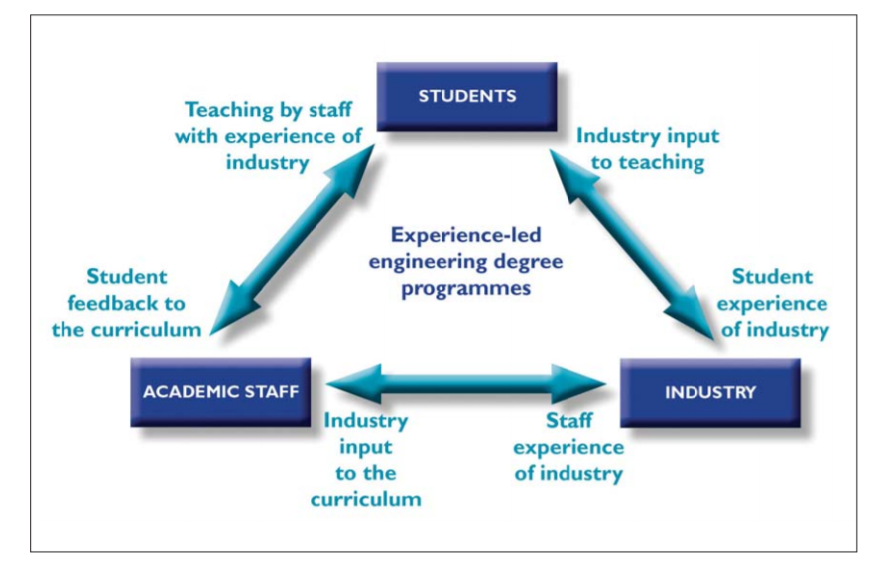
What do students expect to see and experience when they enter a UK engineering school? One attribute that clearly stands out is that the generic UK Engineering Degree is built on a strong tripartite relationship between staff, students and industry that directly impacts both teaching and curriculum development(Lamb et. al. 2010). Figure 1 illustrates this three-way relationship:

engineering-led degree.png

Figure 1: Relationships between academic staff, students and industry for experience-led engineering degree programmes – Adapted from the Engineering Graduates for Industry Study report (Lamb et. al. 2010).

Teaching

From the diagram in Figure 1, industry contributes significantly to the teaching that takes place in UK engineering schools. For example, in design & skills modules, practitioners from industry work alongside academics to deliver the module as well as to assess student work. Practitioners from industry also present guest lectures, in which they they share their experiences and knowledge. Some practitioners are also employed by universities as visiting lecturers and professors. In this role, they take charge of the teaching and assessment of industry-specific modules, including supervising and mentoring students during work placements.

With regard to academic staff, an increasing number are being directly recruited from industry. Whilst the traditional academic and research staff focus on teaching theory and material related to their research, staff recruited from industry are responsible for design & skills based modules, and for supervising projects with an industrial element to them. Hence, in the typical UK engineering school, students get to be taught by academic researchers and industry experts, and this provides an enabling environment for students to systematically integrate theory and practice.

Curriculum Design

The design of the generic UK Engineering Degree is also carried out in partnership with industry. As a general rule, all UK engineering degrees are either accredited, or are aspiring to get accredited, by the Engineering Council. Teams comprising people drawn from industry and universities are responsible for setting the accreditation standards and for monitoring and evaluating individual degree programmes. Within universities, industry liaison boards comprising academics and industry representative oversee the engineering degree programmes that are taught in individual institutions. Again, at the programme and module level, academics and industry practitioners work together, formally and informally, in designing core aspects of the curriculum.

Role of the Students

Students are actively involved in the design and delivery of their programmes. They provide formal and informal feedback on the quality of teaching. For instance, in the UK, student liaison committees comprising both academics and students meet regularly to review the teaching. Furthermore, in some institutions, students also sit on academic recruitment panels, which means that recruitment decisions are now jointly carried out by both academic staff and students. Within the class, students also contribute to the creation of course module material, and are also actively involved in assessment as peer assessors.

Concluding Remarks

In conclusion, the generic UK Engineering Degree is now an established feature of the UK higher education landscape, and it is time that it is properly acknowledged as such. To quote from Professor Nigel Seaton, a chartered chemical engineer who is now Principal and Vice-Chancellor at Abertay University, UK engineering degrees “are good degrees to have, and equip students for a wide range of jobs. While many students embark on an engineering career, others thrive in a range of jobs, for example in management or finance” (Sellgren, 2011).

References

Lamb, F., Arlett, C., Dales, R.,  Ditchfield, B., Parkin, B. & Wakeham, W. (2010). Engineering graduates for industry. The Royal Academy of Engineering.

The Royal Academy of Engineering. (2007). Educating engineers for the 21st Century.

Sellgren, K. (2011). Engineering graduates ‘taking unskilled jobs’. BBC News. Available at http://www.bbc.co.uk/news/education-14823042. (Downloaded 11 Dec 2016).

The Experience Factor: It Matters

I have long been an advocate for internships and work experience. My reasons are two-fold: First, work experience helps students to integrate theory and practice.  Secondly, and perhaps more importantly,  I have come to know from the experiences of hundreds of students that it facilitates a pathway into that all important first graduate job. However, despite this awareness, I had never sat on the other side of the table as an employer who has the unenviable task of sifting through hundreds of applications to choose the next set of potential graduate recruits. One large employer finally gave me this opportunity,  and what a huge learning experience it has been for me!

One thing immediately became clear to me after I had gone through tens of applications, and reading through the various employment statements: Work experience neatly divides a pool of applicants into two: those who are in a ready state to be employed, and those who are not ready, despite their excellent academic performance.

Key on the employer’s list were the applicant’s leadership skills,  awareness of business practices, and team-working skills. Applicants with little or no work experience struggled in all these categories, particularly in those instances where the application process required them to provide approapriate examples. At best, their examples looked unreal, contrived, wish-washy, and definitely out of this world. Some were hilarious, to the point of bordering on comedy. And comedy they would have been, except that these were applications from serious individuals who had spent four years in university, had attained good grades, and were looking for their first real jobs. Yes they had all graduated, yet quite a significant number of these applicants had no idea of what to expect in a job.

Another important lessson that I learnt is this: It pays to think back on what went well, and what went wrong in your work experience. For example, some of the applicants had clearly reflected on their experiences. In their applications, they  discussed their personal achievements, honestly took stock of their shortcomings, and suggested what they could have done better, and how work processes could be improved to accomodate interns and  early-stage employees. Some of these applications even went further to identify specific areas where the applicant  thought they would need additional training and support. I realised that employing such an applicant would certainly make the job of everyone within the technical department that much easier, and it was quite clear that any of these applicants would be able to fit into the organisational work culture very well.

This was not so with the other applicants with substantial work experience. This category simply narrated what they had done. They gave no indication that they had thought about their work experiences, or that they had learnt anything at all. For most of the applications in this category, it appeared as if they had simply gone through the motions of work experience without engaging with their roles. They certainly looked disinterested and unmotivated. Perhaps this was down to inexperience in writing applications. But given the significant investments made by universities in student career services, this is quite difficult to believe. Whatever the reason, for this particular large employer, this simply reduced to: Who in their right mind would want to employ a disinterested, demotivated graduate employee? 

If you are a student, the point to take home is simply this: Get a work placement while you can. Your future may depend on it. And when you get one, learn all you can from it. Learn about the role, and learn about yourself as well.

If you are an academic, the take-home point should be this: Make it a point to talk about work placements with your students at every conceivable moment. They may not yet appreciate it. But it matters, and if you care for the future of  your students, just do it.

If you are an employer, the take-home point is this: Open up your work places to students. That may be the greatest service you can do to your bottom-line, your industry , and to society in general.