Engineering: The Mysterious “E” in “STEM”

It has been said that a country’s economy is only as good as the sum-total creativity of its citizens. That is true. Today, creativity goes hand in hand with technology; and doing wonders with technology is the realm of Engineering, that mysterious term in the quartet STEM – Science, Technology, Engineering, and Mathematics. In all the countries trying to make it economically, STEM is the buzz-word, and engineering is the way to go.

For the past several decades, five nations have sworn by the term engineering, and they have prospered beyond their wildest beliefs. Because of their phenomenal economic and technological success, they are now collectively termed the Asian Tigers. Officially, the Asian Tigers are Hong Kong, Taiwan, South Korea and Singapore. But in any narrative referring to them, Japan is always included, and for good reason – it is the Master Tiger of Technology. Put together, in terms of land-size, these five countries hardly make a blip on the earth’s total land mass. Natural resource-wise, they have next to nothing. Their total natural resources don’t even make 1% of the sum total of Africa’s natural resources.  However, when it comes to wealth, they rank high on all measures of economic performance.

Their products, companies and technological innovations are household names.  Just think of South Korea, and Samsung, Hyundai and LG immediately spring to mind. Turn your thoughts to electronic manufacturing and notebooks, and Taiwan, and its technology conglomerates, Foxconn and Quanta Computer, immediately flash past your memory. And when it comes to banking, your list won’t be complete without the Hong Kong and Shanghai Banking Corporation, otherwise known as HSBC. And if you are both technologically and civic minded, the mere mention of “smart city” and “smart nation” immediately conjures images of Singapore. And of course, you can hardly begin to think about technology, whether it be the nice affordable cars that have flooded the world for decades, or the futuristic robotics that now threaten our own jobs, without ever thinking of Japan.

The economic success of the Asian Tigers is all down to engineering, yet few people here in the UK have got any idea what engineering is all about. Ask any child what a lawyer, doctor, or accountant does, and I bet they can give you a very concise explanation. Ask them what an engineer does, and you draw a blank, or at best they refer you to the “engineer” who comes to repair the drain pipe. Talk about science, and they refer you immediately to all the science stories appearing on television. Except that what is often termed “science” by the professional media is really engineering in practice. “Scientists have designed a super-fast computer; scientists have built a gravity-defying rocket to reach planet Mars” – No! All this is engineering. Scientists discover and test theories, engineers design and build.

So what is engineering? The Oxford online dictionary defines engineering as “the branch of science and technology concerned with the design, building, and use of engines, machines, and structures.” Of course, engineering is all about applying science and technology to the design and construction of all these things, and many others beside them. However, this definition looks a bit stodgy, and distinctly frightening and unappealing, and for me it is quite  incomplete.

I like better their alternative definition: “The action of working artfully to bring something about.”  Bringing together people and technology to solve problems is what engineering is all about. To succeed one has to have a good understanding of the science behind the problem, but above all, one has to be creative, and determined. Here at UCL Engineering we have gone one step further, and define engineering as “the art and practice of changing the physical world for the use and benefit of all.” In short, you can’t talk of engineering without talking of creativity. In today’s world, the two are synonymous.

Want to be a Tech Entrepreneur? – Start young, go where the action is, and stick at it

I love football, and one thing I have noticed is this – All the football super-stars have this in common – they started playing football from a very young age, joined the right teams, and they kept going in spite of all the challenges thrown at them.

I also love tennis, and I have also noticed the same pattern – All the tennis mega-stars have one thing in common – they started playing  from a very young age, entered into the right competitions, and they kept playing tennis, day in and day out, despite any challenges thrown in their way.

I love engineering, and anything to do with technology, and I often wonder – how can a determined, ambitious person rise to become a mega-star in the world of engineering and technology? Wikipedia provided the answer for me – Virtually all the big names in tech today all have one thing in common – they started tinkering around with technology from a very young age, went to the universities and places where the action was, and kept going until they made the technological and commercial breakthroughs they aspired to.

I think I now have a theory for success in engineering and technology, and it is this:

  1. Start young, keep at it, and keep going and don’t give up. (Parents and teachers, take note.)
  2. Get connected with those at the cutting edge of technology in your area of interest. (In practice this generally means going to a university and joining a department where all the action is taking place.)

To test out this theory, I listed five of the top tech companies in the world, and then looked at the early lives of their founders.  In the process, I also came across Aaron Levie – founder of cloud computing company, Box.  The idea for his company started out of a class project, and led directly to the formation of Box.  This leads me to wonder how many student projects are gathering dust somewhere in an academic’s office when they could have turned out to be giant technology companies. I also wonder how many brilliant engineers are toiling away in the bottom rungs of the engineering career ladder, when they could have been leading successful tech start-ups? Anyway, here is a summary of what I found out, courtesy of Wikipedia.

1.      Google Self-Driving Car Builder: Anthony Levandowski (Twitter address: @ottodrives)

Anthony Levandowski was born on March 15, 1980. He built the Google self-driving car while working as a co-founder and technical lead on the project.

In 1998 Levandowski entered The University of California, Berkeley in Berkeley, California, where he earned bachelor’s and master’s degrees in Industrial Engineering and Operations Research. At university he developed and launched an intranet service, and with fellow students, he built an autonomous motorcycle, nicknamed Ghostrider, for the DARPA Grand Challenge.

2.       SpaceX and Tesla Co-Founder: Elon Musk (Twitter address: @elonmusk)

Elon Musk was born on June 28, 1971. He is the founder, CEO, and CTO of SpaceX; co-founder, CEO, and product architect of Tesla Inc.; co-founder and chairman of SolarCity; co-chairman of OpenAI; co-founder of Zip2; and founder of PayPal.

At age 10, he developed an interest in computing and began to teach himself computer programming. At age 12 he developed and sold the code for a BASIC-based video game he created called Blastar, to a magazine called PC and Office Technology, for approximately $500.

At age 19, he went to Queen’s University in Kingston, Ontario, for undergraduate study. In 1992, he transferred to the University of Pennsylvania, where, at the age of 24, he received a Bachelor of Science degree in physics from its College of Arts and Sciences, and a Bachelor of Science degree in economics from its Wharton School of Business. Musk extended his studies for one year to finish a second bachelor’s degree. While at the University of Pennsylvania, Musk and fellow Penn student Adeo Ressi rented a 10-bedroom fraternity house which they used as an unofficial nightclub.

In 1995, at age 24, Musk started on a PhD in applied physics and materials science at Stanford University, but left the program after two days to pursue his entrepreneurial aspirations in the areas of the Internet, renewable energy and outer space.

3.      Facebook Co-Founder: Mark Zuckerberg (Twitter address: @MarkZuckerbergF)

Mark Zuckerberg was born on 14 May, 1984. He is the chairman, chief executive officer, and co-founder of Facebook.

Zuckerberg began using computers and writing software in junior high school. His father taught him Atari BASIC Programming in the 1990s, and later hired software developer David Newman to tutor him privately.

In 2004, whilst studying at Harvard University, Zuckerberg and a group of friends launched Facebook. They introduced Facebook to other college campuses, and the rest is now history.

4.      Spotify Co-Founder: Daniel Ek (Twitter address: @eldsjal)

Daniel Ek is the co-founder and CEO of the music streaming service Spotify.

In 1999, by age 16, Daniel Ek was already a successful entrepreneur building websites. Along the way, he started asking himself: How do you get people to pay for music that can be downloaded free—and without charging them for each song, the way Apple’s iTunes service does now?  The search for a solution to this question led him directly to form Spotify, a jukebox in the cloud that provides legal, on-demand access to millions of songs.

5.      Box Founder: Aaron Levie (Twitter address: @levie)

Aaron Levie  is the co-founder and CEO of the enterprise cloud company Box.

The idea for Box originated as a college business project that Levie was working on in 2004. The project examined cloud storage options for businesses. After contacting several organisations to ask how they are storing their content and data, Levie decided to develop and launch an online file storage business that enabled individuals to access and store documents and files.

In December 2005, during his junior year at USC, Levie took a leave of absence to launch Box (originally called box.net) with his friend and Box CFO, Dylan Smith who was attending Duke University.

6.      Twitter Founder: Jack Dorsey  (Twitter address: @jack)

Jack Dorsey was born on 19 November, 1976. He is a co-founder and CEO of Twitter, and founder and CEO of Square, a mobile payments company.

By age 14, Dorsey had become interested in dispatch routing, a method for assigning employees or vehicles based on the routing system’s pre-planning. Some of the open source software he created in the area of dispatch logistics is still used by many taxi cab companies. Dorsey attended the Missouri University of Science and Technology before subsequently transferring to the New York University Tandon School of Engineering, where he came up with the idea of Twitter and decided to drop out of university.

UK-based Engineering Education Research (And Related) PhD Theses (2000 -2021)

https://orcid.org/0000-0001-8976-6202

Over the years there have been a lot of conference publications by UK-based authors  in the field of Engineering Education. There has also been a growing number of journal publications by UK-based authors. This implies that more and more UK academics are now seriously engaging with the field of Engineering Education. However, the number of PhD theses focussing on Engineering Education and related fields, including such fields as Engineering Practice, still lags behind most academic disciplines. In this article I list all these PhD theses that I could find that have been awarded to UK-based students since the year 2000.

Why should we be interested in the number of PhD theses in Engineering Education, you may wonder. There are severa reasons, but the most important one is that the number of PhD theses in a particular field indicates the level of serious thought, research and innovation taking place within that field. According to the website FindAPhD, a PhD (Doctor of Philosophy) is an advanced postgraduate degree  involving three or more years of independent research on an original topic that is carried out with the support of one or more expert academic supervisors. Hence the publication of a PhD thesis is indicative of a sustained period of research collaboration on a particular topic by two or more people. It also indicates the growth in the number of experts in that particular research field.

I have carried out a search of the British Library E-Theses Online Service (EThOS)  to identify Engineering Education related theses that have been awarded in the UK since the year 2000. Some of them focus on the History of Engineering, whilst some focus on Engineering Practice. I believe that by bringing all these theses in one place they can serve as a useful quick reference for someone who needs to have a quick overview of the current and recent work  that has been taking place within the UK Engineering Education Research  and related fields.

I’m sure this list is not comprehensive. If you know of a PhD thesis that I have missed, let me know via the comments section and I will add it to this list.

McCrone, Georgia2021Further Education lecturers’ early career development and identity : policy, practice, and discourseLancaster University
Fletcher, Ashleigh Jane2020Development and evaluation of open-ended learning activities to support chemical engineering students’ developmentUniversity of Strathclyde
Olukayode Olusola, Awonuga2020Skills gap assessment to enhance the delivery of technical and vocational education : a case study of electrical installation graduates in Ogun and Kaduna states of NigeriaUniversity of the West of England, Bristol
Mabley, Seren2020A qualitative analysis of students’ naturalistic learning processes during their first experience in problem-based learningUniversity of Strathclyde
Jahangiri, Nooshin2019An exploration of female students’ choices, experiences and future aspirations of studying undergraduate mathematics and engineering programmes in IranUniversity of Manchester
Ismail, Norhariati2019An analysis of staff perceptions of their preparedness for the implementation of active learning in Malaysian engineering education : exploratory approachAston University
O’Toole, Chris2019The lived experiences of ICT and Engineering Faculty teaching in higher education institutions in Ireland and the United Kingdom, who adopt and implement mobile technology enhanced learning initiatives : a phenomenological investigationLancaster University
Zainuddin, Suhaiza2019Investigation into the effectiveness of practical work in achieving curriculum objectives for engineering studies in secondary educationUniversity of Lincoln
Onyia, Uzor2019Improving the supervisory and managerial skills and competences required in construction management in NigeriaLondon South Bank University
Grover, Robert2019A critical issue? : educating for sustainability in the architectural design studioUniversity of Bath
Atesh, Manal Habeeb2019Assessing ethics education effectiveness in engineering programmes : a multi-phase approachUniversity of York
Snape, Kirsty2019An exploration of students’ experiences of placement in computing and engineering : a sociocultural analysis of learningUniversity of Huddersfield

Broadbent, Rebecca
2019Children’s experiences of engineering education activities in rural schools in England at age 9/10 : the implications for engineering education and our approach to building engineering career aspirations in young peopleAston University
Jackson-Cole, D.2019Navigating toward success : Black and Minority Ethnic students in postgraduate science, technology, engineering and mathematics courses in EnglandUniversity of East London
Jenns, Caroline Louise2019Understanding Emirati women’s reasons to study the STEM-related subject of engineering : lessons from Dubai
University of Liverpool
Tang, W. F. F.2019An investigation into how the Science and Engineering curriculum in higher education institutions supports undergraduates entering the Testing and Certification industry in Hong Kong upon graduationNottingham Trent University
Mavromihales, Michael2019Enhancing teaching-learning effectiveness in Mechanical Engineering education through structured interventions and Action LearningUniversity of Huddersfield
Mahmud, Mohd Nazri2018Interdisciplinary learning in engineering practice : an exploratory multi-case study of engineering for the life sciences projectsUniversity of Cambridge
Pg-Ya’akub, Dk S. R.2018The impact of online learning : mechanical engineering education perspectivesLoughborough University
Shawcross, Judith Karen2018Manufacturing excellent engineersUniversity of Cambridge
Nyamapfene, Abel Zvamayida2018Teaching-only academics in a research intensive university : from an undesirable to a desirable academic identityUniversity of Exeter
Dziallas, Sebastian2018Characterising graduateness in computing education : a narrative approachUniversity of Kent
Akeel, Usman2018Engineering sustainability : devising a suitable sustainability education intervention for the Nigerian engineering curriculumUCL (University College London)
Moffat, Kenneth Alexander2018Unexpected journey : from autoethnography to a Bourdieusian analysis of engineering educationUniversity of Edinburgh
Derr, Katja Susanne2018Mathematics for engineering students in the ‘Dual System’ : assistance in study start-up and conductUniversity of Plymouth
Jackson, Noel R.2018Comparing active and didactic pedagogies in electronic engineeringStaffordshire University
Sani, Maryam2018Women’s representation in STEM related education and careers : a case study of female university students in Saudi Arabia Staffordshire University
Varga-Atkins, Tunde2018Designing curricula to develop digitally capable professionals in engineering and management : the case in two universitiesLancaster University
Larson, Adam Howard2017Becoming technicians in the ‘hydrocarbon state’ : transitions into post-compulsory vocational education and training in the State of QatarKing’s College London
Vijay, Venkatesh Chennam2017A Knowledge Based Educational (KBEd) framework for enhancing practical skills in engineering distance learners through an augmented reality environmentBirmingham City University
White, Carol2017A critical review of evidence for the claims and perceptions of a shortage of science and engineering graduates in the UKUniversity of Sussex
King, D. C.2017The Engineering Council’s influence on Building Services Engineering education and qualifications : towards an internationalist education and training modelLiverpool John Moores University
Morgan, Thea Rose2017Constructivism, complexity, and design : reflecting on group project design behaviour in engineering design educationUniversity of Bristol
Shah, Raza2017Property inference decision-making and decision switching of undergraduate engineers : implications for ideational diversity & fluency through movements in a Cartesian concept design spaceUniversity of Cambridge
Bull, Christopher Neil2016Studios in software engineering education Lancaster University
Abul-Ola, Mohammad Mahmoud2016How can the education-industry partnership within the Qatari oil & gas industry facilitate engineering graduates’ transition from school to work and enhance their engagement with the labour market? University of Leicester
Hill, S.2016The entrepreneurial engineer : an investigation into the relationship between humanitarian engineering and entrepreneurshipCoventry University
Bataw, Anas2016On the integration of Building Information Modelling in undergraduate civil engineering programmes in the United KingdomUniversity of Manchester
 Sivapalan, Subarna2015Engineering education for sustainable development (EESD) for undergraduate engineering programmes in Malaysia : a stakeholder defined framework University of Nottingham
Herman, Clem2015Gendered careers in science, engineering and technology : transforming spaces and changing identitiesOpen University
 Kenan, Thuraya2015Improving the effectiveness of e-learning implementation in the School of Engineering at Tripoli UniversityUniversity of Huddersfield
Byroms, Richard2015William Fairbairn : experimental engineer and mill-builderUniversity of Huddersfield
Vickerstaff, Rebecca2015Implementation of technology enhanced learning pedagogy and impact on employability and learning within engineering education frameworksUniversity of Plymouth
Mohammed, Abdul Majid2014Integrated technologies instructional method to enhance bilingual undergraduate engineering studentsBrunel University
 Kockelbergh, David2014The origins of student misunderstanding of undergraduate electrical machine theoryLoughborough University
Johnson, Anthony2014Sustainability – its incorporation into the mechanical engineering design processUniversity of Huddersfield
Morley, Helen Ruth2014What can be done to improve the ethical decisions made by engineers?University of Leeds
Routledge, Patrick2014A strategy for enhancing the learning experience of Indian marine engineering students in transnational educationUniversity of Sunderland
Tan, Joyce2013Negotiating the occupational landscape : the career trajectories of ex-teachers and ex-engineers in SingaporeInstitute of Education, University of London
 Tudor, Jenna2013An exploratory investigation into the context specific perceptions and practices of second year mechanical engineering undergraduatesNorthumbria University
Liyanage, Lalith2013A case study of the effectiveness of the delivery of work based learning from the perspective of stakeholders in Computing, Engineering and Information Sciences at Northumbria UniversityNorthumbria University
Sach, Rien2013The impact of feedback on the motivation of software engineersOpen University
Zhang, Dan2013Effective teaching of technical teamwork to large cohorts of engineering students in ChinaQueen Mary, University of London
Woodrow, Michael2013Educating engineers for a holistic approach to fire safetyUniversity of Edinburgh
Hamblin, Katy Joanne2013Men of brain and brawn and guts’ : the professionalization of marine engineering in Britain, France and Germany 1830-1914University of Exeter
 Phuong, Nguyen H.2013Engineering education for sustainable development in Vietnamese universities : building culturally appropriate strategies for transforming the engineering curriculum towards sustainable developmentUniversity of Gloucestershire
Al-Hamad, Salah Madhi Ahmad2013Blended learning system for further and higher education mechanical engineering courses in BahrainUniversity of Huddersfield
Hunter, Kathleen Allison2013Gender and science in twentieth-century British engineering : an interdisciplinary analysisUniversity of Oxford
Tan, Kia Ann Aaron2012Learning patterns of engineering students in a Singapore tertiary education context and the implications for continuing education in the field of engineeringDurham University
Gartland, Clare2012Cultivating rough diamonds’ : a study of student ambassadors’ contribution to widening participation schemes in engineering and medicine at two contrasting universitiesInstitute of Education, University of London
Gao, Mingyi2012A theoretical model for the effectiveness of project-based learning in engineering design educationLoughborough University
Carter, Alan2012Assessment-in-action : a study of lecturers’ and students’ constructions of BTEC national assessment practice in a college engineering programme areaUniversity of the West of England, Bristol
Tzanakou, Charikleia2012Beyond the PhD : the significance of boundaries in the early careers of highly qualified Greek scientists and engineersUniversity of Warwick
Cockerton, Caitlin2011Going synthetic : how scientists and engineers imagine and build a new biologyLondon School of Economics and Political Science (University of London)
Mokhtar, Mahani2011Exploring the intentions, expectations and experiences of female Ph.D. students in the fields of education and engineering at one university in MalaysiaUniversity of Bristol
Taylor, Annette Louise2011Engineering mathematics and virtual learning environments : a case study of student perceptionsUniversity of Plymouth
Gallagher, John P.2011Changing relationships of the state, the professions and higher education in contemporary Ireland : the examples of medicine, law and engineeringUniversity of Sheffield
Soltani-Tafreshi, Fakhteh2010The impact of industrial sponsorship on students, academia and industryLoughborough University
Hopkinson, Viviana2010Why do I have to do key skills? : accounting for year one engineering college students’ perspectives on work and vocalisational education : a case studyThe Open University
Russell, M.2010A personalised assessment programme in engineering educationUniversity of Hertfordshire
Grierson, Hilary J.2010Towards principles and project memories for distributed-design information storing in engineering design educationUniversity of Strathclyde
Powell, Abigail2009The (un)balancing act : the impact of culture on women engineering students’ gendered and professional identities Loughborough University
Hasan, H.2009Exploring engineering employability competencies through interpersonal and enterprise skillsCoventry University
Pei, Eujin2009Building a common language of design representations for industrial designers & engineering designersLoughborough University
Cowley, David2009Student perceptions of the impact of Science and Engineering AmbassadorsUniversity of Brighton
 Thompson, Mark S.2009The rise of the scientific soldier as seen through the performance of the Corps of Royal Engineers during the early 19th centuryUniversity of Sunderland
 Shin, Inyoung2008English for Korean postgraduate engineering students in the global academic community : perceptions of the importance of English, skills-based needs and sociocultural behaviours Institute of Education, University of London
Phillipson, A.2007The business of engineers’ : the organization and education of military engineers during the eighteenth century University of Portsmouth
Arbuckle Araki, M. H.2007Japanese engineering and Scotland : Ryūgakusei and Oyatoi between 1865 and 1900University of Edinburgh
Cooke, Robert Stewart2006The use of alternative energy technologies in buildings : the influence of engineering consultants Brunel University
Oriogun, Peter Kehinde2006Towards understanding and improving the process of small group collaborative learning in software engineering education London Metropolitan University
Webster, Michele Marie2006Key skills and personal attributes in the engineering technicians’ curriculum : a study of two further education institutions in Hong Kong and EnglandUniversity of Leicester
Fang, Woan Pin2005Teaching and learning in higher education : a case study of engineering students learning economicsDurham University
Phipps, Alison Elisabeth2005Women’s education in science, engineering and technology : researching the arena of activityUniversity of Cambridge
 Sng, Bee Bee2005Academic staff’s responses to educational changes in a School of Engineering in a university in SingaporeUniversity of Leicester
Robinson, Paul.2004Contributions to multidisciplinary engineering education and trainingUniversity of Hull
Butchers, Ann Marjorie2004Learning off the job : engineers and professional educationUniversity of Sheffield
Tan, Hock Soon2003The use of a virtual environment in the education of engineering studentsDurham University
Koutsantoni, Dimitra2003Rhetoric and culture in published and unpublished scientific communication : a comparative study of texts produced by Greek and native English speaking engineersUniversity of Birmingham
Doyle, S.2003Differences and similarities between minority groups in U.K. undergraduate engineering coursesUniversity of Cambridge
Cooper, Timothy2003Science-industry relationship: the case of electrical engineering in Manchester 1914-1960..University of Manchester
 Nasr, Atef Ali Mohamed.2002A reading improvement programme for engineering trainees in Egypt University of Ulster
Ahmad, Abdul Rahim2002An investigation of major change in the future world of work for engineers and the consequences for educational practicesLoughborough University
McDermott, Anne Patricia2002Internet delivery mechanisms for the continuing professional development of the marine engineerUniversity of Plymouth
Rivera Martell, David F.2002Introducing environmental concerns within an undergraduate engineering curriculum: A case study of innovation in a Mexican universityUniversity of Sussex
Awang-Ngah, Zainab.2001Exploring the factors related to academic publication productivity among selected Malaysian academic engineers.Loughborough University of Technology
Brooks, Donald Andrew John2001Training the military engineer : a study of assessment and its validityOpen University
 Brown, Keith Bordinel.2000A case study of the changes to engineering education in the UK from 1987 to 1999.University of Lancaster
Intaraprasert, Channarong2000Language learning strategies employed by engineering students learning English at the tertiary level in ThailandUniversity of Leeds
Alias, Maizam2000Spatial visualisation ability and problem solving in civil engineeringUniversity of Surrey

Blended synchronous learning and teaching: Is this the future of university teaching?

https://orcid.org/0000-0001-8976-6202

For the past twenty  years or so we have been wondering when the disruptive influence of the Internet will start having an impact on university education. It appears the long wait is over. The university as we know it is about to change, and the culprit is a curiously named emergent learning and teaching mode known as blended synchronous learning.  In this article I look at this emergent learning and teaching mode with my main objective being to shed light on the fundamental changes that the Internet is now bringing to university-level teaching.

Advances in Internet technology now enable lectures to be simultaneously delivered to students physically located in a classroom and to students located away from the classroom. Web-conferencing technologies such as Adobe Connect and Blackboard Collaborate as well as room-based videoconferencing systems such as Polycom are proving particularly effective at facilitating blended synchronous learning via Internet-connected computing equipment like desktops and laptops.

Blended synchronous learning is defined as “learning and teaching where remote students participate in face to face classes by means of rich-media synchronous technologies such as video conferencing, web conferencing or virtual worlds” (Bower, Matt, et al., 2015). Whilst there are still several issues to be resolved with regard to teaching quality, these concerns are diminishing.  Some researchers are even finding out that student learning outcomes for students taught using blended synchronous learning now outperform all other modes of teaching, including face‐to‐face teaching in the traditional classroom (Hastie, Megan, et al., 2010).

Modes of blended synchronous learning

Hastie, Megan, et al. (2010) have proposed various ways for integrating physical classroom and cyber classroom settings in order to connect teachers and students from any part of the world.

Teacher located in a physical classroom

Teachers can be located in a physical classroom, just as in the traditional face-to-face brick-and-mortar classroom. In this case the teacher can be teaching to students present in the classroom, or to remote students viewing and participating in the class via the Internet, or to both physically present and remote students.

Enhancing face-to-face brick-and-mortar classroom teaching

In the modern face-to-face brick-and-mortar classroom, students physically interact with the teacher, and also engage with the lecturer via networked computer devices. For instance, students can use clickers to respond to questions, or they can post questions via text messaging and chat rooms.

Integrating local and remote students

In another scenario, which is now increasingly becoming the norm in most master-level programmes, the teacher could be simultaneously teaching students who are in the same physical classroom with them, and online students who are logged in remotely from their homes or workplaces. This scenario makes it possible for students who would be physically unable to attend classes to do so remotely via the Internet. This includes international students living and working in their own countries to log onto the Internet and participate remotely in a class taking place in another country.

Enhancing study-group tuition and institutional co-teaching

In another scenario, which grew out of distance learning, the teacher delivers lectures in a physical classroom, and students gather together in one or more remote physical classrooms and engage with the teacher directly via the Internet. In this scenario, the teacher is beamed into the remote student classrooms, and in the simplest case, students can individually connect with the lecturer via chat text messaging. In more advanced scenarios, the remote student classroom is beamed back to a screen in the teacher’s physical classroom. This enhances the interaction between the teacher and the remote student classroom.

This scenario is effective for study group modes of learning whereby students get together in a classroom and participate in lectures delivered by a teacher located remotely. It is also effective in situations whereby a local institution engages another institution to deliver some or all its lectures on a particular programme. This is particularly important in postgraduate engineering teaching whereby institutions can actually deliver postgraduate courses in areas in which they lack the necessary expertise simply by linking up with another institution with the necessary expertise. In both instances, the quality of learning is improved when teaching assistants are assigned to the remote physical classroom.

Enhancing collaborative teaching between institutions

Blended synchronous learning can also facilitate collaborative learning and teaching between different institutions. For example, postgraduate students taking a module on development studies at a UK-based university can collaboratively study with their counterparts at an African university. A possible scenario would be to have the two physical classes linked via Internet, with the classes being simultaneously beamed to each other. Both UK-based and African-based students would be able to see and interact directly with each other. In addition, chatroom technology can be used to enable individual students to communicate with each other. Teachers from both institutions could take turns to deliver combined lectures, and other teachers can be brought in remotely to enhance the learning experience of the students.

Teachers located Online

Another variation is to have teachers delivering their classes online via the Internet. For instance, lecturers can deliver their classes entirely online via personal laptops in the comfort of their homes, or guest lecturers can participate remotely in co-delivering classes with other teachers who are physically present in a classroom.

Online teaching enhances access to subject expertise

A major advantage of online teaching is that it makes it easier to bring subject expertise into the classroom. A university can enhance its teaching by hiring eminent teachers to conduct one or more lectures for their students without them having to leave their countries to travel to the university. Indeed, it is becoming common for subject-matter experts based at particular institutions to conduct lectures for other institutions via the Internet.

With regard to employability, online teaching is also making it possible for guest lecturers from industry to co-teach with university lecturers without having to leave their day-jobs. This is helping to bring industrial expertise directly to the classroom without inconveniencing both the industrial expert and their employers. Indeed, with the increased emphasis on project-based and design-based teaching, this mode of co-delivery is likely to become commonplace.

Concluding Remarks

A lot of work is currently taking place to try to understand blended synchronous learning better. I have included a short bibliography at the end of this article that may be helpful to anyone wanting to get to grips with this topic. Some of us may choose to ignore this emerging learning and teaching mode, but we do so at our own peril. As someone said, it is better to take charge of change, rather than let change take charge of you.

Bibliography

Ho, Curtis P., and Richard W. Burniske. “The evolution of a hybrid classroom: Introducing online learning to educators in American Samoa.” TechTrends 49.1 (2005): 24-29.

Rogers, P. Clint, Charles R. Graham, and Clifford T. Mayes. “Cultural competence and instructional design: Exploration research into the delivery of online instruction cross-culturally.” Educational Technology Research and Development 55.2 (2007): 197-217.

Lin, Qiuyun. “Student satisfactions in four mixed courses in elementary teacher education program.” The Internet and Higher Education 11.1 (2008): 53-59.

Rovai, Alfred P., and Hope Jordan. “Blended learning and sense of community: A comparative analysis with traditional and fully online graduate courses.” The International Review of Research in Open and Distributed Learning 5.2 (2004).

Bower, Matt, Andrew Cram, and Dean Groom. “Blended reality: Issues and potentials in combining virtual worlds and face-to-face classes.” Curriculum, technology & transformation for an unknown future. Proceedings ascilite Sydney (2010): 129-140.

Bower, Matt, et al. “Design and implementation factors in blended synchronous learning environments: Outcomes from a cross-case analysis.” Computers & Education 86 (2015): 1-17.

Hastie, Megan, et al. “A blended synchronous learning model for educational international collaboration.” Innovations in Education and Teaching International 47.1 (2010): 9-24.

White, Carmel Parker, et al. “Simultaneous delivery of a face-to-face course to on-campus and remote off-campus students.” TechTrends 54.4 (2010): 34-40.

Employment outcomes of engineering graduates: The stubborn issues

The Royal Academy of Engineering recently published its report on employment outcomes for engineering graduates for the year 2013/14. The good news is that the employability credentials for engineering remain strong, with 81% of engineering graduates in 2013/14 managing to be in full-time work, further study or a combination of both 6 months after graduation. Of course, this is significantly better than the corresponding figure of 76% for all graduates. However, a closer look at the figures reveals that still, all is not well. The perennial issues pertaining to gender diversity, ageism, social and ethnic exclusion are still evident in the engineering employment figures, and it is these issues that I focus on in this article.

First, engineering is still the only discipline where male graduates outnumber female graduates in employment 6 months after graduation. The only consolation is that this gap appears to be closing. But this pales into insignificance when you realise that women make up just 12-15% of the cohort. This is an agonisingly small proportion given that women increasingly outnumber men in most subject areas. In fact, a woman stands a better chance of securing a job within 6 months of graduating in virtually any other subject area when compared to engineering.

Is it that engineering employers still shun female graduates, even now when we are in a supposedly more enlightened age? Or is it that somehow university lecturers are still in the business of killing off any female interest in engineering? Of course, there have been improvements on both issues compared to previous years, but it is quite clear that these improvements have not gone as far as we would wish. As the saying goes, the last mile is the hardest, and this appears to be the case here.

Again ageism still reigns supreme in engineering. Graduates over the age of 25 are more likely to be unemployed than their much younger colleagues. In fact, you can easily double your chances of being unemployed simply by turning 25 years or more. Added to this, you are significantly more likely to be unemployed 6 months after graduating if you opted to do your engineering degree at a post 1992 university instead of going to a traditional research intensive university. Is it that the teaching in post 1992s is particularly bad? Certainly not. In fact, these institutions are at the forefront of leading innovation in engineering education.

This apparent ageism can only mean one thing: If you are from a working class background and aspire to improve yourself by taking an engineering course at the local university down the road, then you may have to be prepared for the worst. Clearly, ageism and institutional exclusivity have implications for social mobility, and because of this, these two issues need to be addressed by all members of our engineering community.

We in the UK pride ourselves for our ethnic inclusivity. Indeed, we have made huge strides in addressing ethnic exclusion in various areas of our lives. Sadly, for engineering this is still work in progress. When it comes to graduate employability for non-white, or Black or minority ethnic (BME) graduates, engineering comes out at the bottom. For the year in question, 2013/14, only 46% black graduates were in employment 6 months after graduating, compared to 71% of white graduates. Also, whilst 60% of white graduates secured jobs in engineering, only 40% of BME graduates managed to do so.

Finally, whereas in all subject areas your chances of securing a job are diminished if you fail to get a 2.1 or better, this is acutely accentuated in engineering. Here academic snobbishness still reigns supreme, and it does so to such an extent that failing to get a 2.1 or better means that you double your chances of being without a job 6 months after graduation. This is unfortunate, since it is still a moot point within the engineering sector whether or not there is a correlation between a graduate’s degree classification and performance at work. Were this correlation to be established beyond any reasonable doubt, then our quest for more effective and authentic learning, teaching and assessment methods would be over.

So what can we say? Only that for everyone involved with engineering, our work is still cut out. We still have much to do before gender, age and ethnic inclusivity are achieved in engineering. And for those still unemployed 6 months after graduating, don’t give up. And for engineering employers, give our non-traditional graduates a chance. After all, diversity improves innovation, and who knows, your organisation’s future may depend on that one non-traditional graduate whose CV you have committed to the paper shredder.

Student Assignments, Missed Deadlines and the Planning Fallacy

https://orcid.org/0000-0001-8976-6202

The tendency to put off, delay or postpone doing a task is a very common feature of student life, especially when it comes to submitting assignments. This tendency to put off things is known as procrastination, and when it comes to submitting assignments, no matter the length of time available to do an assignment, only a few students submit well before the deadline. The majority tend to submit on or close to the deadline, and a significant few miss the deadline altogether. Those who submit well before the deadline tend to spread out their work over the available period. In contrast, those submitting close to the deadline, or after the deadline, tend to start their assignments with only a few days to go. In fact, it is not uncommon for students to work throughout the entire night prior to the deadline, and to miss classes in the days leading up to the deadline.

Procastination and its consquences

Apart from disrupting other academic activities around the deadline period, the tendency for students to procrastinate has a number of other consequences. First, for the students involved, it can be highly stressful, and has potential health implications. Second, it is likely that in the rush to meet the deadline, stressed-out students may produce low quality assignments, leading to low academic grades. Third, there is a high possibility that students can be overwhelmed by the amount of work they have to do in a very short time, and as a result they may end up not submitting at all.  In fact, from my experience, persistent non-submission of coursework is generally a strong indicator for student non-progression.

According to Pychyl and his colleagues [2000], procrastination is viewed mainly as a time management problem. This view suggests that people who habitually procrastinate have problems with, or are biased, in their time estimation. For example, most people have a tendency of giving lower time estimates for how long it takes to complete tasks. This tendency still persists even when the people concerned have been involved in similar tasks which ended up taking longer than the time they had initially anticipated. This doesn’t apply to students alone, but to professionals as well. For instance, it is a fact of life that IT projects habitually overrun and often exceed budget estimates. Kahneman and Tversky [1977] have coined the term “planning fallacy” to refer to this tendency to make optimistic estimates of task completion despite the fact that most similar tasks have been completed later than anticipated.

Research on the planning fallacy

Researchers working on planning fallacy have observed that people tend to overestimate how much they can accomplish in a given period of time, and they continue doing so even when they know that the estimates that they made for previous tasks have been wrong [Buehler, Griffin & Ross, 1994]. This applies to both novices and experts, and, in our case, to both students and engineers. This suggests that when we estimate the time we will take to accomplish a task, say an assignment, we often don’t take into consideration past experience, or the experiences of others on similar tasks. As Kahneman and Tversky [1977] suggest, we tend to focus exclusively on the specific aspects of the problem at hand, and neglect to take into account any outside information that may affect the task. For example, when deciding when to start an assignment, we may focus only on how difficult the assignment questions are, and whether the solutions can be found in the lecture notes or we need to go to the library. We don’t take into consideration such things as the possibility that we may fall ill, or that some event may occur that will prevent us from fulfilling our tasks. In short, we don’t put in place any contingency planning.

 However, Buehler and colleagues observed that the planning fallacy vanishes when individuals are asked to forecast other people’s task completions. For example, students can accurately predict whether or not their colleagues will be able to submit on time, and, more ominously for academics, students are often able to accurately predict that Professor So-and-so will not return their assignments by the set deadline.

Why are we accurate at predicting other people’s task completions and not our own? One suggestion is that whilst we can accurately perceive another individual as a procrastinator, when it comes to us, we generally view ourselves as victims of circumstances. Another suggestion is that we are so certain of ourselves and our capabilities that we believe we don’t need any additional information when making decisions about ourselves. On the contrary, we are often aware of the lack of complete knowledge that we have about our colleagues, so to address this we often seek out additional information before we make a decision on their time completion [Buehler, Griffin & Ross, 1994].

How can we resolve the planning fallacy problem?

Kahneman and Tversky [1977] suggest that the planning fallacy is intrinsic to individuals to the extent that we often become compellingly attracted to our erroneous estimates even when we are fully aware that they can be wrong. We can therefore only resolve the planning fallacy by letting our beliefs be guided by “a critical and reflective assessment of reality, rather than our immediate impressions, however compelling these may be” [Kahneman & Tversky, 1977]. However, carrying out critical and reflective assessment of your own behaviour and capabilities is easier said than done.

A better approach is to draw on the findings by Buehler and his colleagues and find someone else to analyse your behaviour and capabilities and to give you time estimates on the tasks you are working on. This fits in with our modern ideas that learning is not an individualistic process, but a team process [See my blog entitled Excelling in Engineering School: Collaborate – Being smart is not enough]. To be more effective in your academic studies, you need to work with colleagues, and to take advice from them. Working with colleagues and listening to their advice, no matter how much we may dislike it, will make us better students. And this includes accepting the advice that we are not super heroes when it comes to doing assignments, but, just as any other student, we need to set aside more time than we think we do.

References

Buehler, R., Griffin, D., & Ross, M. (1994). Exploring the” planning fallacy”: Why people underestimate their task completion times. Journal of personality and social psychology67(3), 366.

Kahneman, D., & Tversky, A. (1977). Intuitive prediction: Biases and corrective procedures. Decisions and Designs Inc., Harvard University.

Pychyl, T. A., Morin, R. W., & Salmon, B. R. (2000). Procrastination and the planning fallacy: An examination of the study habits of university students. Journal of Social Behavior and Personality15(5), 135.

Getting that UK Scholarship – Some Guidelines for Engineering Applicants

https://orcid.org/0000-0001-8976-6202

The UK remains one of the most preferred international destinations for both undergraduate and postgraduate study, especially in engineering and the sciences.  Drivers for this include the widespread respect accorded to UK degree programmes as well as the academic research undertaken by UK universities. Competition for university places and for scholarships is therefore stiff, and as the Top Universities website acknowledges, UK education doesn’t come cheap.

Several scholarships are available for international students. If you are intending to study engineering, this includes scholarships from individual universities, engineering institutions and organisations, as well as the government. Currently the largest scholarship programmes are the government-funded Commonwealth Scholarship schemes and the Chevening scholarship programme. These are both open to all study programmes in addition to engineering.

Criteria for Securing a Scholarship

The main reason for seeking a scholarship is financial. However, this alone is not enough justification for you to be awarded a scholarship.  Scholarship applicants have to meet additional criteria listed by the scholarship awarding bodies.  As a basic requirement, scholarship applicants have to meet the stated minimum academic requirements if they are to be considered. For instance, one of the chief scholarship awarding bodies, the Institution of Engineering and Technology (IET),   clearly states that its scholarships are “intended to reward excellence rather than alleviate financial hardship.”

For most scholarship programmes, academic excellence is only one of a number of criteria that applicants must meet.  As a general rule, awarding bodies seek to award scholarships only to those candidates who will help them to meet the goals and missions of their funders.  For example, both the Commonwealth and Chevening programmes are designed to further the foreign policy objectives of the UK government. These objectives include poverty reduction and socio-economic development in the countries of origin of funded scholars, as well as the development and maintenance of international relationships between the UK and the scholars’ countries of origin. In fulfilment of these goals, applicants for Chevening scholarships have to demonstrate that they have the potential to be future leaders, influencers, and decision-makers in their own countries and beyond. Similarly, applicants for the Commonwealth Scholarship Commission have to demonstrate that they meet the stated academic criteria and that they have the potential to positively impact the development of their own countries after graduation.

Scholarship criteria that go beyond mere academic excellence are very well suited to prospective engineering students. This is because the goal of most engineers is to use their knowledge to make a difference in their own communities. This may include designing and building engineering systems and products such as roads, bridges, telecommunication systems, electrical power supply systems, or developing cheaper and safer approaches for producing medicines.

Why You Need to Prepare

There is more to submitting an application for a scholarship than the mere physical act of filling in an application form and sending it to the awarding body. In reality, when you fill in an application form, you are saying to the awarding body: “I am fully aware of your mission goals, and I fully subscribe to your objectives. If you invest in me by paying for my education, I will contribute to the fulfilment of your mission objectives, and I am the best person to do so.”  Hence, your goal as an applicant is to fully demonstrate to the awarding body that you fully meet their criteria, and the only way you can do so is by giving well-thought-out responses to the questions in the application form, and in subsequent interviews.

As a general guideline, I would suggest that you should spend at least two to three years preparing for your application. Ideally, if you are submitting your application for the 2017-18 academic year, you should have started thinking of applying for the scholarship in 2014, or 2015 at the latest. This means that if you are in the final year of an undergraduate programme, and you are intending to apply for a postgraduate scholarship immediately after graduating, your preparations should have started at the same time that you started your undergraduate programme. On the other hand, if you made the decision to go for postgraduate studies after completing you engineering studies, then you would need to have spent an additional two to three years building up the necessary non-academic evidence to support your application. Why, you may ask.  Because the best predictor for your future performance in any role is your current and past performance in similar or related roles.

As an applicant you may be tempted to exaggerate or manufacture your past experiences. However, this is not helpful at all.  Such applications are easily picked out during the selection process. This means that unwarranted exaggerations and concocted lies only add up to a waste of time for both the applicant and the selection panel.

Preparing Yourself for the Scholarship Application Process

Russell Campbell has written an application guideline for law graduates seeking a Chevening scholarship. His article forms the basis for much of my discussion in this section. However, one thing that you will notice is that the three suggestions that I give in this section  are remarkably similar to the additional activities that you should be participating in as an engineering student or as an early-stage graduate engineer.

Gain work experience

Just as work experience is important for you in securing your first graduate engineering job, it is just as important if you are planning to go on for a master’s degree. Work experience provides you with a context around which you can formulate any future studies. It allows you to form a precise idea of your motivation for doing further studies, and enables you to clearly articulate this to the scholarship awarding body. Most importantly, work experience enables you to identify any gaps in knowledge and experience that you need to address if you are to increase your potential to create future benefits to your organisation, engineering field and your country, and the rest of humanity.

Work experience also gives you the opportunity to work on various projects. This is very valuable, as projects tend to be multidisciplinary, and enable you to see the wider picture relating to your engineering practice. Rather than thinking in a task-oriented manner as articulated in many early-stage job-descriptions, you learn to appreciate the wider societal impact of your role. In addition, you also learn and develop the leadership skills that you need in your future career.

Work experience also gives you the opportunity to work with more experienced engineers and to watch and learn from them.  All these individuals have different approaches to engineering practice and leadership. By watching and working with them, you will gain a practical appreciation of effective and ineffective leadership styles, and this will enable you to reflect and improve on your own leadership skills.

Develop Relationships with Potential Referees

References are an important part of the application process. Experienced colleagues working in the field that you intend to pursue in your studies are important potential referees. Working with such people gives them the opportunity to assess your strengths and weaknesses and to write a detailed reference that clearly articulates how your personal attributes make you suitable for the scholarship that you are applying for. Such references are distinctly different from those written by colleagues who only have a superficial view of you.

You should also seek out opportunities to volunteer. This may involve taking an active role in your engineering institution, or getting involved in community welfare projects. Volunteering gives you opportunities to develop relationships with mentors outside of your organisation. Although this may be unpaid, it will contribute to your long term professional development.

Actively Build a Strong Academic Reference

Most students shy away from participating in academic extra-curricular activities, and once they graduate, they never make an effort to contribute to the academic training of student engineers. However, engineering education has increasingly adopted active learning approaches such as project based learning. The demand for practising engineers and older students to advise and guide learners has therefore increased.

It is important to have a strong academic reference, and an easy way to to do so is to  contribute your time and skills to student learning. You will get to work alongside academics, and to establish personal relationships with them. This means that potential academic referees have the opportunity to assess how your academic skills in the class room are translated into real world problem solving. More than that, by offering your services to your local engineering school, you build relationships with individuals who will have a genuine interest in your career and will more than likely be happy to provide you with strong academic references. This will set you apart from other applicants who never bothered to help out in engineering schools.

The UK Engineering Degree:  an Experience-led Brand

There are over 120 UK universities offering master’s and bachelor’s degrees in various engineering disciplines. As one would expect, each of these engineering degrees is influenced to some extent by the people who teach on it as well as the ethos and culture of the institution offering it. However, if one takes the time to scan the various institutional web pages, it quickly becomes clear that there are common strands running across all UK engineering degrees. In fact, these commonalities are so extensive and far-reaching, and so uniquely British that I believe it is time we started talking about the UK Engineering Degree as a generic brand encompassing all UK engineering degrees.

There are several reasons why we should identify and characterise the UK Engineering Degree brand, and these include:

  • Prospective students applying to get into a UK Engineering degree programme will have a clear picture of what is involved in studying for an engineering degree in the UK;
  • Employers will have a very clear understanding of the capabilities, qualities and characteristics of engineering graduates from UK universities;
  • The UK Engineering Degree brand will serve as a common reference standard which stakeholders such as employers, government departments, academics and students will use to objectively compare degree programmes, to evaluate and monitor learning and teaching processes in each programme, and to encourage and guide innovation in engineering education.

Defining the generic UK Engineering Degree

The key distinguishing feature of the UK Engineering Degree is the strong integration between theory and practice. In the typical UK engineering school, theory is not taught for the sake of theory. Rather, theory is taught to be put into practice.  In general, students get introduced to theory, followed by practical demonstrations, and then they are expected to apply the theory to problem solving.  Mini-projects are an integral part of most UK course modules, and these mini-projects are often designed with input from industry. Furthermore, the UK Engineering Degree also has stand-alone design & skills modules where students learn to apply the theory they have learnt across several modules to the analysis and solution of industry-type problems. These design & skills modules simulate industry conditions in that students are presented with a problem, and they then work in teams to come up with appropriate solutions within a specified time-limit. Because of this, the UK Engineering Degree is best classified as an experience-led degree programme.

The term “experience-led engineering degree” first appeared in the report for the Engineering Graduates for Industry Study that was commissioned by the UK government in 2008 (Lamb et. al. 2010). The main purpose of this study was to identify effective practices within current and developing engineering degrees that went some way towards meeting the needs of industry as identified in the Royal Academy of Engineering’s Educating Engineers for the 21st Century report. The study defines an experience-led engineering degree as an engineering degree which develops industry related skills and which may also include industry interaction.  Industry related skills comprise all those skills and attributes which make an engineering graduate work-ready.

The Ideal Skill-set for a UK Engineering Graduate

On the basis of the information presented on the various UK institutional websites, the ideal work-ready engineering graduate  has indepth theoretical knowledge of their chosen discipline and is a competent problem solver, with highly developed analysis and numerate skills, and one who is also well-rounded, with an understanding of the impact of engineering on society, and with experience of working in teams.  According to the Royal Academy of Engineers, the ideal engineering graduate should have

  • Appropriate technical knowledge, understanding and problem solving skills;
  • A full appreciation of life cycle processes and Systems Engineering;
  • People and professional skills, team-working, co-operative strategies and leadership;
  • A commitment to lifelong learning.

Essential Features of the Generic UK Engineering Degree

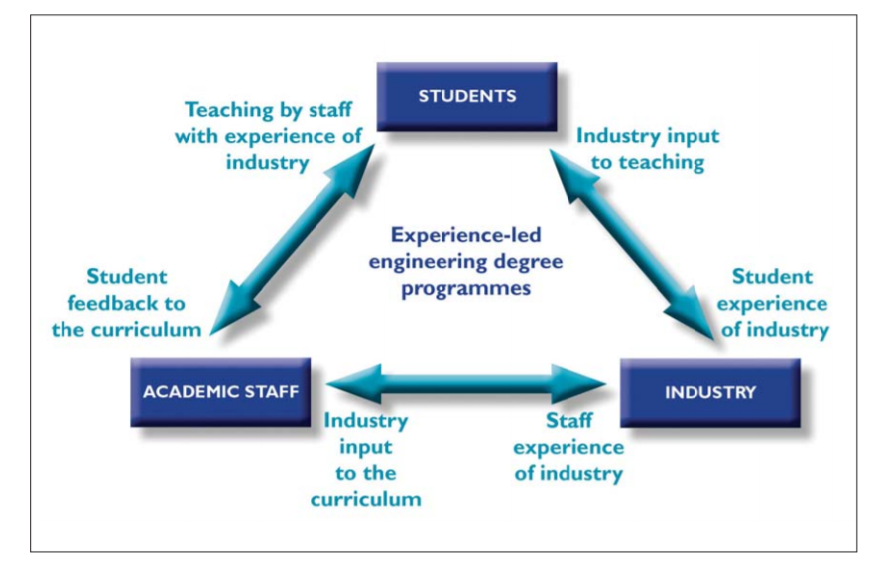
What do students expect to see and experience when they enter a UK engineering school? One attribute that clearly stands out is that the generic UK Engineering Degree is built on a strong tripartite relationship between staff, students and industry that directly impacts both teaching and curriculum development(Lamb et. al. 2010). Figure 1 illustrates this three-way relationship:

engineering-led degree.png

Figure 1: Relationships between academic staff, students and industry for experience-led engineering degree programmes – Adapted from the Engineering Graduates for Industry Study report (Lamb et. al. 2010).

Teaching

From the diagram in Figure 1, industry contributes significantly to the teaching that takes place in UK engineering schools. For example, in design & skills modules, practitioners from industry work alongside academics to deliver the module as well as to assess student work. Practitioners from industry also present guest lectures, in which they they share their experiences and knowledge. Some practitioners are also employed by universities as visiting lecturers and professors. In this role, they take charge of the teaching and assessment of industry-specific modules, including supervising and mentoring students during work placements.

With regard to academic staff, an increasing number are being directly recruited from industry. Whilst the traditional academic and research staff focus on teaching theory and material related to their research, staff recruited from industry are responsible for design & skills based modules, and for supervising projects with an industrial element to them. Hence, in the typical UK engineering school, students get to be taught by academic researchers and industry experts, and this provides an enabling environment for students to systematically integrate theory and practice.

Curriculum Design

The design of the generic UK Engineering Degree is also carried out in partnership with industry. As a general rule, all UK engineering degrees are either accredited, or are aspiring to get accredited, by the Engineering Council. Teams comprising people drawn from industry and universities are responsible for setting the accreditation standards and for monitoring and evaluating individual degree programmes. Within universities, industry liaison boards comprising academics and industry representative oversee the engineering degree programmes that are taught in individual institutions. Again, at the programme and module level, academics and industry practitioners work together, formally and informally, in designing core aspects of the curriculum.

Role of the Students

Students are actively involved in the design and delivery of their programmes. They provide formal and informal feedback on the quality of teaching. For instance, in the UK, student liaison committees comprising both academics and students meet regularly to review the teaching. Furthermore, in some institutions, students also sit on academic recruitment panels, which means that recruitment decisions are now jointly carried out by both academic staff and students. Within the class, students also contribute to the creation of course module material, and are also actively involved in assessment as peer assessors.

Concluding Remarks

In conclusion, the generic UK Engineering Degree is now an established feature of the UK higher education landscape, and it is time that it is properly acknowledged as such. To quote from Professor Nigel Seaton, a chartered chemical engineer who is now Principal and Vice-Chancellor at Abertay University, UK engineering degrees “are good degrees to have, and equip students for a wide range of jobs. While many students embark on an engineering career, others thrive in a range of jobs, for example in management or finance” (Sellgren, 2011).

References

Lamb, F., Arlett, C., Dales, R.,  Ditchfield, B., Parkin, B. & Wakeham, W. (2010). Engineering graduates for industry. The Royal Academy of Engineering.

The Royal Academy of Engineering. (2007). Educating engineers for the 21st Century.

Sellgren, K. (2011). Engineering graduates ‘taking unskilled jobs’. BBC News. Available at http://www.bbc.co.uk/news/education-14823042. (Downloaded 11 Dec 2016).

The Experience Factor: It Matters

I have long been an advocate for internships and work experience. My reasons are two-fold: First, work experience helps students to integrate theory and practice.  Secondly, and perhaps more importantly,  I have come to know from the experiences of hundreds of students that it facilitates a pathway into that all important first graduate job. However, despite this awareness, I had never sat on the other side of the table as an employer who has the unenviable task of sifting through hundreds of applications to choose the next set of potential graduate recruits. One large employer finally gave me this opportunity,  and what a huge learning experience it has been for me!

One thing immediately became clear to me after I had gone through tens of applications, and reading through the various employment statements: Work experience neatly divides a pool of applicants into two: those who are in a ready state to be employed, and those who are not ready, despite their excellent academic performance.

Key on the employer’s list were the applicant’s leadership skills,  awareness of business practices, and team-working skills. Applicants with little or no work experience struggled in all these categories, particularly in those instances where the application process required them to provide approapriate examples. At best, their examples looked unreal, contrived, wish-washy, and definitely out of this world. Some were hilarious, to the point of bordering on comedy. And comedy they would have been, except that these were applications from serious individuals who had spent four years in university, had attained good grades, and were looking for their first real jobs. Yes they had all graduated, yet quite a significant number of these applicants had no idea of what to expect in a job.

Another important lessson that I learnt is this: It pays to think back on what went well, and what went wrong in your work experience. For example, some of the applicants had clearly reflected on their experiences. In their applications, they  discussed their personal achievements, honestly took stock of their shortcomings, and suggested what they could have done better, and how work processes could be improved to accomodate interns and  early-stage employees. Some of these applications even went further to identify specific areas where the applicant  thought they would need additional training and support. I realised that employing such an applicant would certainly make the job of everyone within the technical department that much easier, and it was quite clear that any of these applicants would be able to fit into the organisational work culture very well.

This was not so with the other applicants with substantial work experience. This category simply narrated what they had done. They gave no indication that they had thought about their work experiences, or that they had learnt anything at all. For most of the applications in this category, it appeared as if they had simply gone through the motions of work experience without engaging with their roles. They certainly looked disinterested and unmotivated. Perhaps this was down to inexperience in writing applications. But given the significant investments made by universities in student career services, this is quite difficult to believe. Whatever the reason, for this particular large employer, this simply reduced to: Who in their right mind would want to employ a disinterested, demotivated graduate employee? 

If you are a student, the point to take home is simply this: Get a work placement while you can. Your future may depend on it. And when you get one, learn all you can from it. Learn about the role, and learn about yourself as well.

If you are an academic, the take-home point should be this: Make it a point to talk about work placements with your students at every conceivable moment. They may not yet appreciate it. But it matters, and if you care for the future of  your students, just do it.

If you are an employer, the take-home point is this: Open up your work places to students. That may be the greatest service you can do to your bottom-line, your industry , and to society in general.


Preparing for an Academic Role – Not Just a Job, but a Calling

https://orcid.org/0000-0001-8976-6202

Before the year 2000, it was quite usual for a considerable number of postgraduate students to secure full-time academic roles even before they submitted their dissertations. Nowadays this has become extremely rare.  It is now only reserved for the very exceptional.

The Current Academic Job Market

Competition for academic roles has now become so intense that it is not unusual for a PhD graduate to go for more than a year before securing an academic role. Even then, the promise of a full-time secure academic role is increasingly becoming rare. Most early stage academic roles, such as postgraduate research or teaching fellow roles are offered on short term contracts, usually one to three years. Alternatively, such roles may be temporary part–time roles. Guaranteed employment can last for as little as a university term in the case of teaching-only roles, and for just the duration of a research project for postgraduate researchers. Some academic appointments, particularly those for teaching, are hourly paid, and they come with no guarantee for progressing to full-time academic roles.

According to the UK Higher Education Statistics Agency (Academic Staff, Table 2), almost 33% of all academics in 2014/15 were on part-time, or casual, contracts. Casualisation amongst academic staff is now commonplace in most Western countries, including Australia, the United States and Canada. For the aspiring academic, this means that the academic job market has become highly competitive.  And yet, for most PhD students, preparing for the job market is usually one of their least consideration. The result is that most PhD students graduate with very high expectations, only to have them ruthlessly shattered as they start in earnest to apply for academic roles.

Preparing for a Career During Your PhD

Ideally, a PhD student should start preparing for a career right from the start of their PhD studies. There is now a lot of career guidance and support in most universities. Over the past five years I have witnessed more and more universities offering career guidance to their graduate students and postdoctoral research staff. This guidance includes training on day-to-day careers stuff such as putting together a CV, writing personal statements, and interview techniques. Universities are now also raising awareness of alternative, and potentially lucrative, non-academic career routes for PhD graduates.  However, when it comes to careers training most PhD students do the barest minimum, usually just doing the compulsory career guidance sessions. Given the tightness of the academic job market, I think this is a big mistake. Preparing for your post-PhD career should be taken just as seriously as pursuing the PhD.

The PhD has traditionally been regarded as an apprenticeship into the academic role. Even though there are now other career pathways in addition to pursuing an academic role, I feel that when you sign up for a PhD, you should still consider yourself as an academic apprentice. There is a lot to learn. This includes taking part in academic seminars and conferences, writing academic papers, and teaching and supporting learning.  All these activities mean that you gain communication and peoples skills that are critical to any professional role. Do not skimp on any of them. All these activities should be part of your day-to-day PhD timetable, starting from day one.

One important thing you need to work at is to stand out from the competition when it comes to job hunting. This requires you to gain competence in at least one skill, and to gain widespread recognition as an expert. For instance, most PhD work in the sciences and engineering requires some computer programming. Develop expertise in a programming language, and seek to gain recognition for that expertise within your subject area and beyond. Contribute to technical forums, and offer to run workshops within your university, and at your disciplinary conferences.

Sometimes your area of expertise may be directly linked to your research area. If this is the case, then make use of academic conferences to gain recognition for this expertise, and seek out opportunities to be a guest speaker in other universities. As more people within the academic field get to know you, then your chances of catching the eyes of decision makers also increases, and with that, the likelihood of securing an academic role.

You should also seek to gain recognition as an expert in teaching. After all, teaching is an integral part of the academic role. Don’t just teach to while away the time and get some payment. Invest time and effort in improving your teaching skills. This includes keeping abreast of current advances in learning and teaching. At the end of each term, students complete their evaluations of your teaching. Teaching excellency is highly prized, especially now as we move into the era of the Teaching Excellence Framework. In addition, most universities now offer Higher Education Academy (HEA) accredited teaching training schemes. These schemes are free for students and staff, and they are worth the effort. Doing one means that in addition to your PhD, you will come out of graduate school with national recognition for the quality of your teaching.

 What if You Don’t Get an Academic Job Before Graduating?

In the present climate getting a permanent academic job is more of playing the long game, and not a 100-metre sprint. At a minimum, you should stay focussed, and continue building on your academic, technical and soft skills. Most importantly, ensure that you remain connected to the academic world. Make it a point to continue publishing and attending your disciplinary conferences. If you live close to a university, look up the seminar schedule for your subject area, and get involved. Attend sessions and also offer to speak on your area of expertise. After all, seminar speakers are difficult to lay hold of. Most subject disciplines have one or more academic associations. Be active in one, thereby ensuring that you remain visible to decision makers within your discipline.

If opportunities for part time teaching or research come up, and they are in line with your field, then consider taking them up. But this is not for everyone as the salary from part-time academic roles is on the low side. However, you could be strategic about this, and take up a role that allows you to pursue a more lucrative career elsewhere. Getting a teaching role ensures that you get access to other academic colleagues, you stay connected to what is taking place in academia, and you can access online databases and publications via the university library website. Most importantly, you are able to build up on your teaching and research skills.

If you are in the sciences or engineering, or in management, another promising route into academia is via a career in industry.   People with industrial experience who are able and willing to teach are increasingly in high demand. This is because undergraduate students are increasingly expected to have industry/business awareness. And designing and running modules which equip students with appropriate industry skills can only be done effectively by someone who has been in industry. Two to three years in industry should be enough to make you competitive in the academic market.

Building Your Own Academic Brand

Finally, when it comes to being an academic, it’s all about branding yourself. Undertaking a PhD means foregoing a salary for three or more years. It also means committing yourself to hard, usually solitary work. For you to have committed yourself to undertaking a PhD, it means you have to be driven by an inner desire to search out new knowledge and to gain expertise in a particular academic field. Therefore, even after the PhD, you should continue with your academic journey. Continue with your research, wherever and whenever possible. And remain engaged with your academic community. After all, unlike most other careers, being appointed to any academic post should be seen as more of getting peer recognition of your academic progress to date, as opposed to simply filling up a role.