London’s Elite Universities and the Global Social Elites

https://orcid.org/0000-0001-8976-6202

Trends in Non-UK domiciled Undergraduate Student Numbers

In the academic year 2014/15, there were 1 727 895 undergraduate students enrolled in UK higher education institutions. 13.4% of these students came from outside the UK, with 4.5% coming from other European Union countries and the remaining 8.9% coming from outside the European Union. This represents a slight increase of approximately 2% in the proportion of non-UK domiciled students over the five year period from 2009/10 when the proportion was 11.3%. However, the distribution of non-UK domiciled students is not uniform across all higher education institutions. Two factors appear to determine the proportion of non-UK domiciled students in an institution, namely the position of the institution on international higher education rankings, and the location of the institution.

The University of Exeter Intercultural Integration Project

In 2009/10 I led a Higher Education Academy funded project to promote intercultural integration amongst Engineering students at the University of Exeter. Apart from myself, the rest of the team comprised three undergraduate students, who, like myself, had lived in, or had significant exposure to, two or more national cultures in addition to the UK. The first student was in the 4th year of the  MEng Civil Engineering programme at the time of the project. He was born in Thailand, and during his childhood he lived with his parents in a number of Asian and African countries. The second one was born in the Philippines, and she had come to the UK with her parents at an early age. She had gone to school in the UK, and her personal networks comprise friends, colleagues and relatives in both the UK and the Philippines. At the time of the project, she was in the second year of the MEng Electrical Engineering  programme.  The third student was a UK-domiciled student, and at the time of the project she was in her second year of the MEng Civil Engineering  programme. She comes from a widely-travelled family, and she is passionate about other cultures, countries and places.

At the time of the project, home students and international students in the Department of Engineering fell into two distinct groups. In lectures, and other class activities, home students kept to home students, and international students kept to themselves. Putting the two student categories into teams was fraught with difficulties. International students felt uncomfortable mingling with the home students, and home students didn’t seem to know of any means to establish links with the international students. The language skills of most international students was at best rudimentary, and there was a perception amongst the students that the interests and goals of the two groups were essentially incompatible. To put it lightly, at the beginning of the project there existed a culture of fear, and mutual suspicion between the two student groups. The project proposed a number of steps that the department and the institution could take so as to foster a collaborative intercultural learning environment. Most of these proposals were adopted, and intercultural integration at Exeter has considerably improved.

Unique Trends in London Elite Universities

From the Higher Education Statistics Agency (HESA) data, as a general rule, the higher the position of the institution on the Times Higher Education World Rankings, the higher the proportion of non-UK domiciled students. In addition, institutions located in large metropolitan cities have a higher likelihood of high numbers of non-UK domiciled students compared to institutions located in smaller cities and towns. For example, an analysis of the top 10 UK universities on the Times Higher Education rankings for 2015/16 clearly shows that London based elite universities have significantly higher proportions of non-UK domiciled students compared to other institutions (Table1). For instance, at 46.54%, the proportion of non-UK domiciled students at the London School of Economics is almost equal to the proportion of UK-domiciled students. Imperial College and UCL are not far behind, with 41.38% and 37.70% of their students being of non-UK domicile.

Within the UK we habitually categorise our students as international students or home students to distinguish non-UK domiciled students from UK-domiciled students. Given the significantly high proportions of international students in London-based institutions, it is doubtful whether this categorisation still holds any academic merit.

The typical London-based elite university is essentially a multinational institution, with a global footprint that reaches to all the corners of the earth. Students come from all over the world. You are just as likely to meet a student from Malaysia, or  Indonesia, just as you are likely to meet a student from India or Pakistan, or from Russia or the Ukraine. You are just as likely to hear Cantonese and Mandarin being spoken as you are likely to hear London Cockney. In fact English dialects like Geordie, Scouse and Northern are considerably rare compared to international English dialects like Indian and Nigerian English. Who then is a home student, and who then is an international student at the typical London global university?

Table 1: Percentage of non-UK domicile undergraduate students for the Top Ten UK Universities in the Times Higher Education World Rankings (2015-16)

UniversityWorld RankingEU and non-EU International Students  as a Percentage of Undergraduate Student Population
Oxford213.00%
Cambridge419.67%
Imperial College London841.38%
University College London1437.70%
London School of Economics2346.54%
Edinburgh2427.61%
King’s College London2723.54%
Manchester5624.57%
Bristol6915.00%
Durham7017.02%

Comparison of Students at Exeter and the London Elite Universities

In 2009/10 when we ran the intercultural integration project at Exeter, the students had somehow unconsciously organised themselves into some kind of unhealthy hierarchy, with home students at the top, and non- European Union students at the bottom. European Union students, and students from Canada, Australia and the USA tended to be on par with home students. It was clear that non-European Union students didn’t feel at home in the institution. They were few in number, and culturally isolated. In this regard, the work by the three students Guy, Katrina and Alice cannot be underestimated. They set out to break down socio-cultural barriers within the student body that, by and large, hearkened back to the colonial era, and that had aspects of social class segregation as well.

At UCL, one of the London elite universities, it is self-evident that students do not fall neatly into the home student/ international student divide. Culturally and academically they are the same. They are all high performing, and they are comfortable speaking in English, and friendships flourish just as well across student nationalities as they do within individual nationalities.  In any case, “international” students are just as likely to speak in English as they are likely to speak in their home languages. Both home and international students appear to share a common background. Most have been to elite schools in Europe and within the UK, and they largely share the same recreational activities.

An international student is just as likely as a home student to talk about skiing, rugby, cricket and polo. Not only that, both home and international students are equally at home in the institution. For most students, regardless of their nationality, UCL is an institution that just happens to be located in London. Period.  In short, students at UCL are already culturally integrated, and for the time they are at UCL at least, nationality counts for nothing.

London Elite Universities and the Global Social Elites

There is compelling evidence that London elite universities are recruiting elite students worldwide. Entry requirements for both home and international students are equally demanding. In fact entry requirements are so demanding that just being offered a place to study at an elite university in London is a mark of honour worthy of celebration for prospective students, whether home or international. In addition, London is expensive, and the globally elite London universities charge significantly high international student fees (Table 2). In fact, such is the pressure for entry into these institutions that it is quite likely that if these institutions were to charge home students the same astronomical fees that they charge to international students, they would still be oversubscribed.Needless to say, London elite universities are now in the business of educating the next generation of the global elites.

Luthra and Platt have recently published a paper on Pakistani international students studying in London universities. The data for their research is drawn from the international survey project on Socio-cultural Integration Processes among New immigrants in Europe (SCIP). In summary, their study concludes that international students are not homogeneous, but that they comprise an elite student class and a middling student class. According to Luthra and Platt, the elite student class is made up of students from the upper levels of society, and these elite students come to London to accumulate the necessary human, social and cultural capital they need to enhance their competitive advantage over other social classes.

It is my contention that whether by design or by accident, London elite universities have transformed into finishing schools for the global elite. In these finishing schools, children of the global elite meet together and build the international networks that will enable them to maintain their status in the whole world. In such a scenario, national boundaries count for little. The world is one, and the soon-to-be global elites are one diverse social class with shared interests and objectives.

Table 2: Annual Tuition Fees for Selected London-based Universities (Taken from institutional websites)

London-based UniversityWorld Ranking


(Times Higher Education)

Annual tuition fee  for 2016-17 (GBP)
Imperial College London826 750
University College London1422 380
King’s College London2721 750
Brunel401-50017 200
Kingston601-80013 000
Greenwich601-80011 200

The Abiding Hold of the Exam on University Education

The exam season is nearly over, the exam results have been released to the students, and I am taking a much needed rest before the conference season starts in earnest at the beginning of July. Walking up and down the campus this week, one is greeted by an unusual silence in the academic corridors. The undergraduate students are all gone. The only people working, it seems, are the masters’ students getting started on their dissertations, the PhD students and the postdoctoral researchers. And the academics need the rest, especially after the tortuous exam marking, and the perennial wrangling that come along with the examination board meetings.

Coming to think of it, there is no disputing that the end of year exam has a particular hold on the university system. A long a time ago, the only method of assessing a student’s progress was through the exam. Now coursework has crept in, and for good reasons, but the exam still holds sway. It largely determines the curriculum, the yearly academic cycle of activities, and the future of the majority of students. This statement might appear sacrilegious, particularly after so much research and effort to provide inclusive and more meaningful assessment of academic progression, but it still remains a fact.

The exam is normally a 2-hour or 3-hour academic exercise carried out at the end of the year, usually in the month of May. In fact, the UK academic calendar is made up of three terms. The first term runs from September/October up to the onset of the Christmas holidays in December. The second term runs from the beginning of January up to the beginning of April. Usually the end of the second term coincides with the beginning of the Easter holidays. The third term starts at the beginning of May, and runs until the end of June. Teaching takes place in the first two terms, and the third term is reserved primarily for revision and for writing exams.

Twenty or so years ago, the exam was the only assessment in most course modules. However, nowadays, most course modules have some coursework in addition to the end of year exam. Some modules nowadays are even entirely assessed through coursework. The reasons for introducing coursework are many, but the primary reason is that it enables the academic to assess various aspects of academic mastery. With coursework, it is feasible to assess critical academic skills such as data gathering and research, critical thinking and academic discourse skills, as well as academic presentation skills. One can assess essay writing skills, argumentation and academic presentations using a variety of media, including the ubiquitous PowerPoint slides, video and even social media. In short, an astute academic can tailor coursework to assess the transformation of an academic into a professional through assessing the enactment of various aspects of academic practice. For example, within engineering, one can assess a student’s leadership and team-working skills, in addition to academic competence in the subject in question. All this can be directly linked with current modes of active learning, to the extent that learning, assessment and feedback become one whole, rather than separate, tenuously related entities. It is therefore arguable that the future is likely to go in favour of more coursework and less and less end of year exams.

But what does the exam assess? Previously, it was widely held that the exam was the only vehicle for assessing mastery of academic knowledge. Students would be questioned on the theoretical concepts covered in course modules, and they would all have to provide answers within a set amount of time, under observation from eagle-eyed invigilators and examiners.  The strength of the exam was, and still is, that a student could demonstrate mastery of academic concepts without any outside assistance, unless, of course, they brought into the exam some forbidden external help.  The exam was also seen to be fair, since all students attempted the exam at the same time, and under the same environmental conditions.

But the exam’s strengths is also its weakness. First, it is best suited to assessing mastery of theoretical concepts, and not mastery of professional practice. An exam result cannot shed light on whether a student is going to be a good engineer or not. All it says is that the student has mastered a certain amount of theoretical knowledge. On the other hand, a well-designed piece of coursework can provide irrefutable evidence of the student’s progression towards professional competence. With properly designed coursework, what you see is what you get. It enables a more rounded assessment of the individual student compared to the exam.

Because the exam is primarily theoretically oriented, the focus of a course module can easily be on examinable theoretical concepts. This means that although the stated module syllabus might cover various aspects of study, an exam will constrain students and academics alike to focus only on a very narrow segment of the syllabus. In fact, the end of year exam has given rise to notions of the hidden curriculum, whereby the actual syllabus followed by students is not the one laid down in the course handbook, but the one gleaned from past exam papers.

Then why does the exam still hold such a high prominence in university education? One reason, in my opinion. The exam is well established; it is part of our university culture, and everyone expects it. Professional bodies such as the engineering institutions expect it, parents expect it, students expect it, and external examiners expect it. In fact, within most exam boards, the exam holds pride of place, even in those courses where coursework forms the bulk of the assessment. And when you have to redesign the undergraduate curriculum, the decision to remove the end of year exam is usually the greatest source of conflict.

And another reason for the continuous hold of the exam on university education is this. It is not easy to design effective coursework. Effective coursework is one that assesses all aspects of course mastery, and one that actively discourages students from copying each other, colluding, or farming out the coursework to professional coursework writers. Effective coursework requires the active involvement of both the teaching team and students throughout the coursework period. Effective coursework requires time, thought and tenacity to put together, and even within universities, these three attributes are not always available. And so the easiest escape route is to go down the end of year exam route.

So what does the future holds then? Simply this, more coursework will creep into the university curriculum, but the end of year exam will continue to hold pride of place, at least for the foreseeable future.

Preparing for Engineering School

At this time of the year I normally receive one or more emails from students who have just finished their high school studies and are waiting to go to university to study engineering. These emails normally go along these lines:

Dear Abel

I have been accepted by such and such university to study such and such branch of engineering. I have finished my Advanced Level exams and expect to get the necessary grades to enter onto the engineering programme. Can you give me some advice on what to expect at university, and the things I need to do to prepare for university?

Regards

Engineering student-to-be

In this blog I will try to address the queries raised in this email. For most of us, the transition from high school to university is not as simple as it seems. At the very minimum, this transition may involve changes to your personal life circumstances, changes in approaches to learning and studying, and it marks your first steps onto the road to becoming a professional engineer. There may be a host of other changes as well, but for me, these three are the ones that clearly stand out. I will now deal with each in turn.

Managing the Changes in your Personal Life Circumstances

Going to university is usually the first time that most young people leave home to go and stay on their own. For a start, as a general rule, you don’t have to worry too much about where you will be living. Most universities offer accommodation to all their first year students. You can opt to live in catered accommodation, which means you don’t have to worry about cooking and cleaning up. However, catered accommodation is usually quite expensive, so if you are on a limited budget, this may not be an option for you. This means that you may be moving into non-catered accommodation.

Whether you move into catered accommodation or not, the most significant thing is that all of a sudden you will be living with other people, other than your family. Depending on which type of accommodation you choose, you may need to share your room with someone else, and to share such important facilities like the bathroom. If you are fortunate, you can have your own accommodation with its separate bathroom and toilet facilities. However, in most cases, you have to share with other students the same living lounge, the same television set, and in the kitchen you will share the same cooker and fridge. Personal cleanliness and etiquette are very important in this situation. Clean up after using the kitchen, don’t hog the television set, and don’t play your music too loud.

At a personal level you will have to learn to do a lot of mundane things on your own, like doing the laundry and your own cooking. You can’t live on pizza and fast food all year round. So the most important thing that you can do now is to improve your cooking skills. Follow your dad or mum into the kitchen, and start cooking. It will be bad at first, but in a few days you will become a good enough cook. For some, cooking is the easy part, and the worst part is cleaning up afterwards. Learn to clean up the cooker after you are done with cooking, and clean your plates and pots as soon as you have finished eating. Don’t leave them in the sink. These are important life skills, and they will make it easier for other students to live amicably with you.

Another important aspect is learning to handle money on a day by day basis. You will need to set aside money to buy essentials, and for entertainment. If you have not started doing so, get into the habit of carefully budgeting your expenses against your income. For most students, you will receive government support at the beginning of the term. If you are not careful, you can blow all this money in the first week of term. Rather, before the money comes in, draw up a list of the essential things that you need to buy, and decide how much money you need to set aside for the rest of the term. When the money does come in, make sure you stick to that plan. Money is the lifeblood of life, and when it runs low, it will impact on your ability to concentrate on your studies.

Going to university can be a huge emotional challenge. Once your parents have dropped you off, and they have gone back home, it will suddenly hit you full in the face that you are alone. You will miss your dad, mum and your brothers and sisters. You will wake up in the middle of the night thinking of home, and wondering why you chose to go to a far-away university in the first place. But remember, your family are also feeling the same about you. And most importantly, they all know that you have taken the next important stage of your life, and they are proud of you, and though you may be separated by hundreds of miles, they are in it together with you. You are never alone. Make sure you keep in touch with your family through regular phone calls, and the occasional week-end rush back home. But above all, make friends with the other students around you.  You are all going through the same experiences, and it helps to have someone to talk to and to share life experiences. And don’t give up, because in a few weeks, it will become normal, and you will get used to living away from home.

The Nature of Engineering School

One thing that you will immediately notice when you start engineering school is that university is very different from high school. Whereas you may have spent the last two years of high school studying three to five subjects in detail, at university you will be studying four to six course modules simultaneously in any given term. Each of these modules will have its own coursework schedule, with non-negotiable submission deadlines. Although universities have done a lot to improve the scheduling of submission deadlines, it is not uncommon to have three or more deadlines falling in the same week. You will need to have very good time management. Buy a diary if you don’t have one, and get into the habit of referring to it on a daily basis. In fact I usually advise my students to always travel with their diary. It is not uncommon to wake up at midnight one day to realise that you have a pending deadline that you had completely forgotten about. If anything, going to university teaches you to value and manage your time.

Another thing that will strike you is the rather impersonal aspect of studying compared to high school. You may have been used to small classes at high school. This is usually not the case at university. Normally in the first year of university, there may be a hundred or more of you taking the same class. Some classes may even have two hundred or more students. You can get lost in a sea of other students. Be prepared to develop relationships with other students. Most students who manage to overcome the challenges of studying at university quickly form study groups of five or more students. They will typically walk together to the library, sit in the same study section, and study the same material at the same time. It is normal practice to see pizza deliveries being made to the library all through the night. If at all possible, don’t be a loner at university, learn to work with others.

Another aspect that may shock you is the intense nature of university studies. As a general rule you will cover in a single lecture an amount of material equivalent to three weeks of study in high school. And because of the compressed nature of university terms, there is normally very little scope for the lecturer to go over the material again. There is usually no time for a gradual introduction of course material. Lecturers are under intense pressure to deliver the syllabus in the given amount of time, which may be no more than thirty or forty hours of teaching time for an entire course module. This means that you have to prepare for your lectures beforehand, and to do follow-up reading after the lecture. Usually all the material is available on the university virtual learning environment. Get into the habit of reading ahead, and reading and doing your assignments in between lectures. Unlike high school, you may be attending not more than four hours of lectures per day.  Don’t get fooled by the seemingly empty lecture timetable. It’s not free time. It is time for you to go into the library and do some serious work. As a general rule, for every hour of lectures, you need to put in four hours of personal study.

At high school you may be used to being taught by a few teachers at any one point in time. You will get to know your teachers very well, and they will also get to know each one of you individually. This is usually not the case at university. You will be taught by multiple lecturers, and sometimes, two or more lecturers will share the teaching on a single course module. And given the number of students in each class, few lecturers get to know ten or more students in any of their first year classes. The same goes for the students – only a few get to know the names of all their lecturers in the first term of university. This can be very difficult for most students, and in some universities, some students can quietly drop out, and despite all the student management systems in place, it can be weeks before someone within the university administration notices.

What does all this mean for you? All it means is that you have to take charge of your learning. This includes working with other students, making sure that you attend your lectures and that you submit your coursework on time. It also means that you have to take the initiative to approach lecturers and course administrators to address any concerns that you may be having.  If a lecturer hasn’t explained something clearly, follow it up. Send an email, go and knock on his or her door, stop them in the corridors, and ask your question. University is a place for asking lots of questions. This is expected of you, ask questions and don’t stop until you are satisfied. In fact, this is one of the key benefits of going to university. You learn to take personal responsibility and control of your own life, and this is a highly sought-after skill when you get into employment.

In general, universities usually provide you with a personal tutor. This is a lecturer from your department, and their role is to support you in your learning. Your tutor will give you advice about how to conduct your studies, and he or she will be interested to know how you are settling into university. If you miss a coursework submission, or if you are not performing as expected, your tutor is usually the first person to know. Make sure that you meet regularly with your tutor, and let him or her be aware of anything that may not be going well in your life. Inform your tutor if you are taken ill, or if you have broken up with your boyfriend or girlfriend and this is affecting your studies. Get to know your tutor very well. They are an important source of information concerning what is important to do at university. Take their advice seriously, and if you are having successes, or challenges, with your education, or any other activities you are involved with in the university and beyond, let them know. Throughout your university life, your tutor is likely to be one of the very few lecturers who will get to know you as a person. They will be there to provide you with work references, and when you start working, they will be important contacts for you if you wish to re-connect with the university.

Connecting with the Engineering Profession

You will be going to university to learn and study your particular field of engineering for three or four years. Most students show up at university with only a hazy idea about their chosen engineering discipline. After the first few weeks, some students may realise that they made the wrong choice. What they thought was engineering may be very different from the reality. Get to know your future engineering field. Search on the Internet all about your chosen discipline. Look at the various engineering syllabuses offered by the various universities, and read all the stories involving engineers in your discipline.

In most countries, there is usually a professional association for engineers. Find out which association engineers from your discipline belong to, and sign up. Engineering associations are always on the lookout for student engineers, and in most instances the cost of joining as a student is very small. And be involved with the association. Attend meetings, even if they may be talking about issues that make no sense to you. Pretty soon, some of those things will be your bread and butter issues. Talk to practising engineers, make friends, and volunteer your time. By doing so you will begin to know a lot about how your engineering discipline is practised, and you will develop useful contacts that may well lead you into your first job.

Everyone has a fair idea what a medical doctor does. In contrast, few people can explain with certainty what an engineer does. Sadly, this includes a large chunk of beginning engineering students.  Knowing what engineers do in every day working life will enable you to appreciate why your course is organised the way it is. It will also help to give you an idea of the additional skills that you need to acquire outside of your engineering classes. Find out which organisations are involved in your field, and ask to shadow one of their engineers for a day.  Most organisations are happy to give prospective engineers some shadowing experience, but they don’t normally advertise. Take the initiative, and ask them, and if they say no, go on to the next organisation. Be persistent.

A day spent shadowing a practising engineer gives useful insights into engineering practice. You get to see the engineer at work, reviewing designs, contracts, answering phone calls and emails, sending instructions to workers involved with projects, and communicating with senior managers within and outside the organisation. Follow the engineer to the tea and coffee machine, and listen as he or she exchanges chit chats with other colleagues. Imagine yourself in their role, and ask yourself: “Is this for me?”

Grooming yourself for Engineering Studies

There is at least three months between the end of high school and the start of engineering school. You can forget a lot in this period, and it is not helpful to turn up at university with a rusty brain. Mathematics forms the basis for most of the course modules that you will be studying at university. Find time to refresh your skills in such areas as trigonometry, differentiation and integration, and probability and statistics.  Most universities usually give advice on the mathematical and scientific skills that you need to have when you come into university. Take time to keep  these essential skills up-to-date. They are the bread and butter of engineering school. If you talk to most engineering lecturers, they will advise you that you need to spend at least half an hour each day, week in, week out, in the study of mathematics. Make the study of mathematics a habit, and this will smoothen your transition into university.

Nowadays computers are central to the study of engineering. You will use spreadsheets like Excel, programming languages and modelling software to simulate, analyse and model engineering problems. Find time to experiment with spreadsheets, especially their use in in graphical plotting and visualising mathematical equations. Again, the Internet is a great source for good practice material.

Most engineering disciplines have courses on computer programming. Even if you won’t be doing any computer programming in your university course, it helps to have an idea of programming.   After all, programming is one of the pillars of this current technological era. Find out which programming languages are taught in your university, and start learning some basic programming. It can teach you a lot about how to organise your thoughts and how to solve problems in a systematic manner. For most programming languages, you can easily download the essential software for free from the Internet, and there are loads of free online courses that you can work through. Start small, be inquisitive, and enjoy reading, modifying and experimenting with the many examples that are available for free on Internet.

Concluding Remarks

As a parting shot, don’t go into panic mode. Getting into engineering school is a very competitive process. The fact that you have received an offer means that you are one of the best engineering prospects out there. Thousands have gone through engineering school, and they have excelled in both their studies and in their job roles after graduating. You are no different from any of them. Believe in yourself. You can do it.

Our Students – They are of all types and they need us

We are now well into the examination season. Students have gone into binge-study mode, and log-ins to Moodle course pages are at an all-time high. And so are the requests for assistance, and requests for clarification on Moodle forums, and via emails. In fact my email box is clogged with student emails asking for all kinds of help, including assistance with understanding some of the equations that I covered in the first two weeks of the year, eight months ago at the beginning of the academic year in October. And some of the names I barely know. And from some of the questions they ask, I am left with little doubt that they have been completely disengaged from my course module until now when they have to prepare for the exam. This has left me wondering on the various categories of students one is likely to meet at university. Here is my attempt at student categorisation.

The Exam Binge-study Student

Of course, since we are going through the exam period, the first group of students that come to my mind are the ones whom I would categorise as exam binge-study students. In a culture where the exam is venerated above all other forms of assessment, these students are the real masters of the modern-day academic game. They play with only one objective in mind – to pass the exam. For them, mastering the nuances of your course is beside the point. They study to the exam, and once the exam is done with, they wait for the next set of exams. Walking along the academic corridors with my ears open, I frequently get confirmations and affirmations that the proper academic year is at most two months, one month to study and prepare for the all-in-all exams, and one month to sit the exams.

The exam binge-study student is a very different creature from all the student profiles that they teach you in the academic staff development centres. They are primarily not interested in the course for its own sake. They are there to get good grades, and they know how to go about it. They collect all the past exam papers they can lay their hands on, and study these to the exclusion of all. As an insurance they demand assurances from you that the exam will be no different from the previous ones. They ask you about the depth of exam coverage, and they come to you and say: “Topic so and so has not been covered for the past so and so years. Is it going to come in the exam?”

If you have recently introduced your course module, they will demand a mock exam. And when they see it, they will want to know to what extent the actual exam will differ from the mock exam. Typical academic responses like “revise all the lecture materials, and work through all the tutorial examples” are not sufficient for this group of students.  They are on a mission to excel, and to excel with the minimum amount of effort, after all there are other more important things to do than spending an entire year on academic studies. In our exam-oriented culture, these students get through, and somehow, I strongly suspect that most of these will go on to excel in industry and wherever they seek employment after graduating. After all, they are masters at concentrating only on the goals that matter at any given point in time.

The Visibly Engaged Students

Then there is the set of students whom I term the visibly engaged students. These are the students that I get to know very well throughout the year. They consistently attend all my lectures and workshops, and even in a lecture theatre of 100 or more, I can easily pick out their faces from the sea of strange faces staring at me. They are normally the ones who ask questions in lectures, and who generally engage with the lecturer. And in group-oriented tutorial workshops, these are the students who are most likely to come prepared, and who contribute the most to group work.

They are the star students, and they are the ones who make teaching such a fulfilling career. Outside of classes, these are the students who follow up on your lecture notes, and ask for clarifications, and sometimes for additional work throughout the entire course. In fact, they are the ones who are most likely to come and knock on your door.

Within the university, these are the students who are visible in all aspects of student academic life. They are to be found on student committees, and on all academic endeavours involving students and academics. And in all likelihood, these are the students who ultimately end up in the leadership of the National Union of Students (NUS). For all practical purposes, they are the student voice, and, though, they are in the minority, it goes without saying that it is ultimately the voice of this group of students that ultimately reaches the top echelons of the university system.

The Intrinsically Engaged Student

Then there are the very few students who make teaching a worthwhile, challenging academic endeavour. These are the students who occasionally post academically challenging queries on the Moodle forums, and who occasionally send you that one email that makes you sit up and send you rushing to the library, or send you scurrying for assistance from fellow colleagues.  I refer to these students as the intrinsically engaged students.

They never ask frivolous questions, but when they do, you can be certain that their question is worth a million student questions. The issues they raise can be so indepth and so fundamental that you are left in no doubt that they are engaged with the subject matter of your course to a far greater detail than all the other students put together. In fact, their questions can be so far-reaching as to cast doubt on the very epistemological and ontological foundations of your course.  In any case, it is these students who can leave you questioning the oft taken for granted “us and them” divide between students and academics.

This group of students is not flustered by academic titles. When they engage you in a conversation, they easily cut through all the weight of academic insignia to reach through to your mortal self. These are the students who engage with you on a person-to-person basis. They are on top of their study matter, and in some instances they are ahead of you in understanding the nitty gritty issues of the course’s subject matter. They can see through assignment questions, and they can challenge your solutions and propose better ones. A classic example for this is the well-known barometer problem first posed by Alexander Calandra, an American Professor of Chemistry. Calandra discussed this problem in a short story entitled “Angels on a Pin: A Modern Parable” that first appeared in the Saturday Review, on 21st December 1968.  In this story, a Physics colleague of Calandra had set the following examination question:

“Show how it is possible to determine the height of a tall building with the aid of a barometer.”

Since it was a Physics exam, the Professor had been expecting a nice, neat Physics answer along these lines:

“Take the barometer to the top of the building and lean over the edge of the roof. Drop that barometer, timing its fall with a stopwatch. Then using the formula S = ½at², calculate the height of the building.”

Most of the students presumably went along with the professor and gave “nice, theory-based” Physics-like answers, as expected. But as it so often happens at university, one student came up with a very unlikely, and very un-physics-like answer:

“Take a barometer to the top of the building, attach a long rope to it, lower the barometer to the street and then bring it up, measuring the length of the rope. The length of the rope is the height of the building.”

Of course, the student’s answer was correct, and as most people would say, this was a more realistic answer than the expected physics-like responses. But, from the academic’s point of view, this question demonstrated no understanding of physics at all, and marking it correct would imply that the student had understood the taught concepts sufficiently enough to apply them to practical contexts.  Nevertheless, the long and short of it is that the student got the marks.

The Dutiful University Student

For lack of a better classification label, I shall call this next group of students the dutiful university student group. These are the students who dutifully attend university and carry out their academic studies. They mostly attend all lectures and all tutorial workshops. They submit their coursework on time, and their academic performance ranges from the “passably fine” to “adequate”. During end of year examination boards, these are the students one hardly looks at. They satisfy all requirements, and dutifully go through university, and go on to be dutifully employed in the world at large.

If you are one of the cynical academics who live only to do discipline-based research, and to chase the Research Excellence Framework (REF), you can wish for no other student category than this group. They rarely ask questions, rarely participate in the various academic surveys, and if pressed to complete some important survey, like the much feared National Student Survey, they dutifully give non-committal answers that do not rock the boat. However, for those academics who believe in the transformative power of the university system, these students are the ultimate challenge. Can this group be challenged enough to raise their game beyond their current level? Can you put enough fire into the bellies of these students and turn them into agents of change, both within the university system and beyond in everyday life?  These are difficult questions, and I suspect that currently no viable solution exists.

And these should be disturbing questions to everyone, industry leaders and the ordinary person in the street included. This is because by and large, it is anticipated that economies of the future will depend on the nature of the skills and attributes possessed by graduates entering the workforce. As far back as 2005, Radcliffe wrote that “innovation and its impact on national wealth creation within a globalized economy are currently high on the political agenda in many countries.” Indeed, entrepreneurship and innovation skills are now some of the most highly sought after graduate attributes and skills, and it is questionable if the dutiful student category, which is by far the largest student category, are innovative, entrepreneurial and adaptive enough to thrive in the competitive and fast-paced dynamic workplaces of the future.

The Disconnected Student

I have opted to call my last student category the disconnected student group. These students typically end up falling out of the university system. This category comprises those students whose class attendance is at best erratic. They submit coursework as and when they wish, and mostly they don’t. If they choose to come to exams, they often get ridiculously low marks, to the consternation and shock of most academics. Compared to other student categories, they are often very few in number, possibly one or two in an average-sized class of fifty.  However, at the end of the year, they often end up taking more than half the deliberation time in the examination boards. They often have quite high entry grades when they come into university, but their academic performance bears no relation to this at all. They are disconnected from academic work, disconnected from the university system, and largely disconnected from the rest of the student body.

These are the students that we, as the university community, are failing. They spend one or two precious years of their lives at university, and ultimately end up with nothing to show for it. Not only that, these students seem to be on a downward spiral to oblivion, and unless they meet with some corrective intervention at some point in their lives, these students are to all intents and purposes lost to society, and lost to their families. As demonstrated by their entry level grades, these students have the potential to excel, but for some reason, possibly non-academic, they lose control of their academic lives. And as a parent, or sibling, one of the most harrowing experiences one can encounter is to witness your child, sister or brother spiralling out of control and into oblivion. And this pain lasts for an entire lifetime, and no cost can be ascribed to it.

Because they are so few, and because they can easily blight a university’s track-record, it makes economic sense to drive these students out of the university system as early as possible. However, as the adage goes, a society is judged by how it treats the least among them. And ultimately we in the university stand to be judged by how we treat these failing students. Of course, this requires professional staff to handle the myriads of problems afflicting this category. But this is not helped by the current economic environment whereby professional services staff are often the first to be laid off whenever cost-cutting measures are mooted. Perhaps the solution could be to share key professional services staff between two or more universities – a pooling together of resources for the mutual benefit of all.

Recognising Teachers in the Life Sciences: A Review

How to cite the reviewed work:

Harris, J. 2015. Recognising Teachers in the Life Sciences. The Physiological Society. London. Available at: http://www.physoc.org/sites/default/files/page/Recognising%20Teachers%20FINAL.pdf [Accessed: 24 April 2016].

Introduction

Within the UK it has been the traditional norm that academics carry out research and teaching as part of their role. However, with the emergence of the Research Assessment Exercise (RAE) in 1986 and its subsequent evolution to the Research Excellence Framework (REF), discipline research is increasingly restricted to academics whose research meets the requirements of the REF/RAE. A direct consequence of this is that an ever-increasing number of academics are now employed solely to focus on teaching, and on education management. However, the literature on teaching-focussed academics in the UK is still limited, hence the growing interest in this publication from the Physiological Society.

Why This Booklet is an Important Contribution

The Physiological Society has made an attempt to further our understanding of teaching-focussed careers through the publication of this booklet entitled “Recognising Teachers in the Life Sciences.” This booklet features 32 academics in the biological and medical sciences who have been promoted at one or more stages in their career on the basis of their contributions to teaching and/or education management. These academics are drawn from three categories:

  • Group 1: Academics whose first permanent appointment was focused on education
  • Group 2: Academics whose career focus switched from discipline-based research or a clinical role to education
  • Group 3: Academics who combine discipline-based research or a clinical role with significant educational activity

The Physiological Society hopes that by publishing this booklet, teaching-focussed academics will have role models to emulate, and universities will have practical examples to help them to develop teaching-oriented promotion criteria for their own academics.

The booklet also provides important advice to those of us seeking to gain recognition and promotion on the basis of teaching and education management. This is because promotion on the basis of teaching is a relatively recent phenomenon. Hence, few or no people on academic promotion committees have any personal experience of the teaching-focussed academic role.  Also, departmental senior academics tasked with appointing and overseeing teaching-focussed academics have little or no guidance on developing roles that have scope for academic progression. Consequently, academic departments often lack the necessary resources to provided adequate mentorship and leadership to teaching-focussed academics.

Areas for Further Research

For the reasons discussed above, the booklet is a very timely addition to the literature on teaching-focussed academics. However, an analysis of the 32 academic careers showcased in the booklet also raises some serious concerns with the teaching-focussed academic role. I will now turn my attention to these concerns.

1: Gender Bias: As Table 1 shows, the 32 academics featured in this booklet are roughly balanced in terms of gender, with 17 being male, and 15 female. In addition, two of the academic categories have significantly more males than females. These two groups comprise academics who switched to teaching-focussed roles from discipline-based research or a clinical role to education, and academics who have maintained these roles in addition to a focus on teaching. In contrast, Group 1 which comprises academics who were appointed directly into teaching-only roles, has only one male and 7 females. Whilst the sample size is too small for these differences to be statistically significant, it is pertinent to establish whether or not the teaching-only academic route, as typified by Group 1, is becoming an academic role to which women are shunted into.

Table 1: Gender Distribution

Group Actual Numbers   Percentage Ratio  
  Male Female Male Female
All 17 15 53.1% 46.9%
1 1 7 12.5% 87.5%
2 11 6 64.7% 35.3%
3 5 2 71.4% 28.6%

2: Parity of Esteem between the Teaching-only Role and the Research and Teaching Role: Table 2 gives the distribution of professors in each of the three groups. Only 25% of teaching-only academics, as indicated by Group 1, have attained professorships. This is in contrast to academics in Groups 2 and 3 where professors make up 64.7% and 71.4% of the groups respectively. Again, whilst the figures in this booklet are too small for these proportions to be statistically significant, one is left wondering if teaching –only academics, as indicated by Group 1, have significantly more difficult chances of securing professorships than academics in the other two groups. One might assume that perhaps this may be due to differences in lengths of services of the academics in the three groups. However, the average length of service for the three groups is 20.5, 26.0 and 25.14 for groups 1, 2 and 3 respectively. These lengths of service appear to be sufficiently close to each other to rule out disparities in length of service as a contributing factor.

In practice, research-focussed academics typically attain professorships within 10 to 15 years on average. Given the relatively high number of non-professors in all three groups, and the average length of services that in excess of 20 years, this may suggest that a focus on teaching is detrimental to academic progression in the current higher education environment.

Table 2: Distribution of Professors by Grouping

Group Total No. of Academics No. of Professors Ratio of Professors to academics (%)
All 32 18 56.25%
1 8 2 25%
2 17 11 64.7%
3 7 5 71.4%
  1. Impact of University Type on Progression of Teaching-focussed Academics: The 32 academics presented in this booklet comprise 23 academics from research intensive institutions and 9 academics from post 1992 non-research intensive institutions. Of the 9 academics from post 1992 institutions, 8 are full professors compared to only 10 of the 23 academics from research intensive institutions. Again, whilst these figures are not statistically significant, it strongly suggests that one is more likely to progress to full professorship in a non-research intensive university than in a research intensive university. Of course it may be argued that the academics covered in this booklet are based on opportunistic sampling and are not representative of all biosciences and medical academics within the UK. However, given the objectives of this booklet, it is reasonable to assume that the editors went out of their way to identify and include those academics with the strongest promotion records.

Table 3: Distribution of Professors and Other Academic Staff Categories by University Type

 University Type No. of Professors Total No. of Other Academics Proportion of Academics who are Professors (%)
All 18 14 56.25%
Non Research Intensive 8 1 88.9%
Research Intensive 10 13 43.5%

Concluding Remarks

The booklet is an important contribution to our understanding of teaching-only academic roles, and I would recommend it to all teaching-focussed academics, senior academics with management responsibilities, and academics serving on promotion committees. For the higher education researcher, the booklet also gives a snapshot of  some of the emergent mutations of the academic role, and also raises important questions regarding parity of esteem and sustainability of teaching-focussed roles vis a vis the established research and teaching role.

Systematic Integration of MATLAB into Undergraduate Mathematics Teaching: Summary of Paper Presented at EDUCON 2016

https://orcid.org/0000-0001-8976-6202

How to cite this study:

Nyamapfene A & Lynch S, Systematic integration of MATLAB into undergraduate mathematics teaching: Preliminary lessons from two UK institutions, IEEE EDUCON, Abu Dhabi, UAE (2016).

Introduction

Computer algebra systems (CAS) are software systems designed for the symbolic manipulation of mathematical objects such as polynomials, integrals and equations [1]. This includes software systems like MATLAB, Mathematica and Maple.  CASs are now routinely integrated into modules in mathematics in most universities [2][3]. Several reasons have been suggested for this high level of CAS use in university level mathematics. This includes perceptions that [2][4]:

  • CASs help to develop mathematical thinking, concepts and skills
  • CASs offer a flexible environment for students to easily explore and experiment with mathematical concepts
  • CASs enable students to visualize mathematical concepts through such features as graph plotting and animation of mathematical functions
  • Pedagogically, CASs help to promote greater conceptual understanding of mathematics by taking away the burden of tedious calculations.

Research Issues

However, despite the relatively high penetration of CASs into university-level education, and their perceived value, it appears that there is significant underutilisation of these technologies [5]. This means that most of the expected benefits of these CASs are not being realised. Therefore, if any benefits are to be realised from investments in CASs in higher education, it is necessary to find out how best to implement CAS use into university level education.

One suggestion has been that most institutions don’t pay proper attention to curriculum design when adopting CASs. Tonkes et al. [6] suggest that  the main reason for this underutilization is that CASs are often added into the existing teaching without proper curriculum design. So a critical question to ask may be: What curriculum design considerations should you make if your CAS implementation is to be successful. We decided to look at two institutions that have integrated MATLAB into their Maths teaching with some measure of success. These two institutions are Manchester Metropolitan University (MMU) and University College London (UCL).   At MMU, MATLAB has been routinely taught as an integral part of their Mathematics undergraduate programmes, and at UCL, the teaching of MATLAB alongside Mathematics has been implemented in to the undergraduate Engineering curriculum.

Our study was guided by these research questions:

  • What are the stated objectives for CAS integration in each of the two institutions?
  • What is the context around the CAS implementation in each institution?
  • What was each institution’s approach to curriculum design during the CAS implementation?
  • What lessons, if any, did the institutions learn from the implementation?

Findings

At UCL the motivation for incorporating MATLAB into Engineering Mathematics was driven by the perception that students often fail to apply the mathematics that they have learnt to the analysis and design of engineering systems. It was hoped that MATLAB would enable students to directly model and solve engineering–related problems within the mathematics course, thereby enabling them to appreciate the role played by mathematics in the study of their disciplines. At Manchester Metropolitan, the main motivation was to improve the employability skills of their Mathematics graduates. It was felt that equipping Mathematics students with MATLAB skills would enable them to understand and appreciate the use of Mathematics in industry. This has turned out to be true, as the employment of their students within 6 months of graduating is now higher than the UK average.

At the time of MATLAB integration at both institutions, there were strong feelings that the then curriculum needed to change. This feeling was shared by both academics and academic leaders. Consequently, in both institutions, MATLAB integration was implemented as part of a wider programme redesign. Teams of academics contributed to the redesign of the entire programmes, and academics collaborated together to design individual lectures, workshop sessions and even the development of course material and assessment questions.

At both institutions, senior management were committed to the programme changes, and resources were made available to support both academics and students. For instance, at UCL a team of postgraduate students was assembled to provide students with out of class support in Mathematics and Matlab. Within the departments, additional staff were deployed to assist lecturers with leading workshop sessions, and with coursework marking.

Recommendations

Based on this study of MATLAB integration at Manchester Metropolitan and UCL, it appears that the following steps can help to improve the chances of a successful MATLAB integration:

  1. Implement MATLAB integration as part of a programme-wide redesign
  2. Ensure students see the benefits of MATLAB
  3. Ensure academics see the need to teach MATLAB
  4. Embed MATLAB into the institutional Maths culture
  5. Provide adequate institutional support for both academics and students

References

  1. Thomson, A. Santaella, and M. Boulat, “Maple and other CAS (Computer Algebra Systems) applied to teaching and assessing mathematics,” School of Doctoral Studies (European Union) Journal, vol. 1, pp. 136-170, 2009.
  2. Buteau, N. Marshall, D. Jarvis, and Z. Lavicza, “Integrating computer algebra systems in post-secondary mathematics education: Preliminary results of a literature review,” International Journal for Technology in Mathematics Education, vol. 17, pp. 57-68, 2010.
  3. Lavicza, “Factors influencing the integration of Computer Algebra Systems into university-level mathematics education,” International Journal for Technology in Mathematics Education, vol. 14, p. 121, 2007.
  4. A. Majid, Z. Huneiti, W. Balachandran, and Y. Balarabe, “MATLAB as a teaching and learning tool for mathematics: a literature review,” International Journal of Arts & Sciences, vol. 6, p. 23, 2013.
  5. Lawrenz, A. Gravely, and A. Ooms, “Perceived helpfulness and amount of use of technology in science and mathematics classes at different grade levels,” School Science and Mathematics, vol. 106, pp. 133-139, 2006.
  6. Tonkes, B. I. Loch, and A. Stace, “An innovative learning model for computation in first year mathematics,” International Journal of Mathematical Education in Science and Technology, vol. 36, pp. 751-759, 2005.
  7. M. Kadijevich, “Neglected critical issues of effective CAS utilization,” Journal of Symbolic Computation, vol. 61, pp. 85-99, 2014.
  8. Bains, J. E. Mitchell, A. Nyamapfene, and E. Tilley, “Work in progress: Multi-displinary curriculum review of engineering education. UCL’s integrated engineering programme,” in Global Engineering Education Conference (EDUCON), 2015 IEEE, 2015, pp. 844-846.
  9. S. Lynch and J. Wilber, MathWorks User Story http://uk.mathworks.com/company/user_stories/manchester-metropolitan-university-students-vote-math-best-overall-course-following-adoption-of-matlab.html    accessed (08/02/16).
  10. S. Lynch, Dynamical Systems with Applications using MATLAB 2nd Ed., Springer International  Publishing, Switzerland, 2014.
  11. Periasamy, “Students’ motivations and actions when they learn mathematics using CAS: a study using an activity theory approach,” PhD. Thesis, Wits School of Education, Faculty of Humanities, University of the Witwatersrand, 2011.
  12. N. G. Lederman and M. L. Niess, “Technology for Technology’s Sake or for the Improvement of Teaching and Learning?,” School Science and Mathematics, vol. 100, pp. 345-348, 2000.

University Curriculum Change & Renewal: Avoiding Extinction

In a BBC article discussing the future of banking, Matthew Wall poses the question: “Is old tech putting banks under threat of extinction?”  Traditional banking systems typically run on mainframe computers. These computers are reliable and can handle huge volumes of transactions, but they are slow. The advent of mobile and online technology has changed the dynamics of banking. Clients now expect transactions to take place anytime, anywhere, and in real time. This calls for fast, agile and flexible computer processing. And the old mainframe technology cannot cope.

Banks have tried to solve this problem by building new layers of modern software technology around the legacy mainframe systems. But the results have been far from satisfactory. The old cannot work with the new, and the results are the computer glitches and inexplicable system breakdowns that are now routine in the banking industry. Naturally, non-traditional competitors have seen an opportunity to make a quick buck, and the large traditional banks are now facing stiff competition from start-ups who are now offering mobile and online banking services running on nimble technology which is free of the legacy mainframe systems.

The old banks are now feeling the heat from competition brought about by a new technological era. And some are likely to go down, to become extinct, like the old dinosaurs. And this has left me wondering about our current university system. So far we have managed to keep the competition at bay. We have managed to incorporate modern technologies into our systems, but in most cases, only as far as augmenting the same teacher-centred educational approach we so much love. Our degree programmes have remained largely the same, and changes have largely been cosmetic –   at most a few changes in teaching approaches in a few modules, but with the core remaining largely untouched. In the few cases where wholesale change has been proposed, this has been quickly snuffed out.

But how long will this status quo last, and if nimble, determined, well-funded, politically connected competitors appear on the horizon, will the old university system cope?  Like the traditional banks, we can choose to wait. After all, universities, like banks, are essentially conservative organisations. However, such a strategy may well spell the end of the university as we know it. An alternative is to do the unthinkable – anticipate the new requirements for university education in the modern day, and implement and take control of change. To my knowledge, only one university has been bold enough, or foolish enough, to anticipate change and take it by the horns, so to speak. This is the University of Melbourne, in Australia, with their now famous, or infamous curriculum, the Melbourne Model. The question I want to address is: If the unthinkable becomes the only alternative, what does it take? Richard James and Peter McPhee (2012) have shared their experiences in implementing a whole-institution curriculum change at the University of Melbourne, and in this blog I will share their insights with you.

In 2007 the University of Melbourne replaced all the 96 undergraduate programmes it had with a new structure comprising six generalist three year undergraduate degrees followed by professional graduate courses. These six undergraduate courses are arts, biomedicine, commerce, environment, music and science. The model was informed by the American undergraduate liberal education system, and by the European Bologna Process. The Melbourne Model seeks to produce graduates with both depth and breadth in knowledge. Breadth is achieved by ensuring that undergraduate students undertake at least 20-25% of their studies in an area outside their core discipline. Depth is achieved primarily through disciplinary specialisation at the graduate level.

Needless to say, this was a highly contentious change process that fundamentally changed the university’s education system, and substantially impacted the entire Australian public university system. Richard James and Peter McPhee suggest that the following actions by the university helped to ensure that the curriculum change process was a success:

  1. The University of Melbourne implemented its curriculum change from a position of strength. It is a highly ranked prestigious university that is highly regarded in both research and teaching.
  2. The process was led by a highly motivated and effective leadership team who advocated publicly and privately for the adoption of the new curriculum.
  3. The university had substantial financial resources which it used to ensure that research activities would not be affected by the curriculum changes.
  4. External stakeholders, including the government, government agencies, and professional associations were engaged throughout the whole process. For instance, government had to be persuaded to support the curriculum change with an appropriate student fee funding structure. Similarly, the university also worked closely with professional bodies in Engineering, Medicine, Dentistry, Law and Architecture to ensure that the new curriculum met with their professional requirements.
  5. Within the university, efforts were made to ensure that the curriculum change process was underpinned by a shared ethos of educational values and beliefs. Time and resources were invested into building consensus on a shared set of educational beliefs across all disciplines.
  6. The university also took into account the values and expectations of students and their families. This also included the views of international students, who made up 25% of the university student body, and who contributed significantly towards student fee income.
  7. The university also considered the implications of the changes on the income flows and business models of the various schools and faculties and made appropriate compromises.
  8. The university also paid attention to the external political implications of the curriculum changes at the university, and took appropriate mitigation steps when necessary.
  9. Careful attention was paid to the logistics associated with the change. Staff, space and time issues were all carefully addressed to ensure that these would not negatively impact the curriculum change process.

Now the dust is settling down. The term “Melbourne Model” has found its way into the higher education lexicon, and the University of Melbourne brand now stands out very distinctly in the Australian higher education landscape and beyond. And this is all because a dedicated, far-sighted  and bold university leadership chose to throw caution to the wind and implement change according to its own belief systems without the constraints brought about by external pressure.

References

James, R., & McPhee, P. (2012). The whole-of-institution curriculum renewal undertaken by the University of Melbourne, 2005–201l. Strategic curriculum change: Global trends in universities, 145-159.

Wall, M. (2016, March 26). Is old tech putting banks under threat of extinction? BBC News. Retrieved from http://www.bbc.co.uk/news/business-35880429.

A Few Key Public Bodies in UK Higher Education

The UK higher education sector is a highly complex sector that comprises higher education providers, both public and private, government bodies and agencies, as well as bodies representing the various stakeholders associated with the sector. In this article, I present a few key bodies that one needs to be familiar with if they are to understand and successfully negotiate their way through the sector.

The Department for Business, Innovation & Skills (BIS)

The BIS is a ministerial department whose key role is to promote and sustain economic growth in the UK. This includes overseeing the development of skills and education to support commerce, promoting trade and innovation, and supporting business set up and growth. Specifically for universities, the BIS oversees the implementation of government policy with respect to higher education. This includes the allocation of research and innovation funding, student tuition fees, and most recently the decision to improve the quality of learning and teaching through the introduction of the Teaching Excellency Framework.

The Higher Education Funding Council for England (HEFCE)

HEFCE is responsible for funding and regulating universities and colleges in England.

HEFCE funding falls into two main categories – recurrent funding and non-recurrent funding. Recurrent funding includes the annual HEFCE teaching grant, which is currently distributed to regulated institutions on the basis of student numbers, the institutional research grant, which is distributed on the basis of performance in the Research Excellence Framework assessment, and, finally, knowledge exchange funding, whose aim is to enable universities to use their knowledge for the benefit of the economy and community. For example an institution can request knowledge exchange funding to establish a business to exploit its research. Non-recurrent funding includes capital funding, and funding for implementing government-mandated initiatives, for example widening participation activities.

HEFCE is responsible for registering higher education providers, maintaining the quality of higher education provision, and ensuring that higher education institutions comply with the UK charity regulations. A quality assessment framework is used to monitor teaching quality. HEFCE also gathers a wide range of student and institutional data, for example the institutional key information sets and the national student survey data. HEFCE also runs the Unistats website, which gives prospective students information and statistics on university courses.

The Quality Assurance Agency for Higher Education (QAA)

The QAA monitors and advises on standards ​and quality in UK higher education. The QAA’s remit applies to all institutions, whether in the UK, or in any location worldwide, which deliver courses leading to UK higher education qualifications. It carries out its work on behalf of the public bodies the fund UK higher education.

The QAA publishes and maintains the UK Quality Code for Higher Education. It also conducts quality reviews of higher education providers and reports its findings publicly. In addition, it also investigates concerns about academic quality and standards, as well as advising government on applications for degree awarding powers and the right to be called a university in the UK.

The Higher Education Academy (HEA)

The HEA is a public body, partly funded by government, and partly funded by UK higher education institutions, whose main objective is to champion and improve the status and quality of teaching in higher education. In this regard it has developed a set of professional standards and guidelines for learning and teaching in higher education known as the UK Professional Standards Framework (UKPSF).  This framework is serving as a basis for assessing and granting formal recognition to individuals who are involved in teaching or supporting learning in higher education. The framework provides recognition for an individual’s efforts to improve the quality of learning and teaching, and includes recognition for wider responsibilities that may include research and/or management activities. For this reason, the UKPSF has become an ideal platform for continuous professional development in learning and teaching in higher education.

The HEA also serves as a national hub for recognised best practice in learning and teaching in higher education. It achieves this through the organisation of teaching and learning conferences and events, and funding and publishing research in learning and teaching.

The National Union of Students (NUS)

The NUS is the umbrella body for higher education and further education student unions in the UK. At present 95% of all higher education and further education student unions in the UK are affiliated to the NUS. The NUS is the key student voice within UK higher education. It achieves this through promoting and upholding the rights of students across UK higher and further education. Students have become important stakeholders in the running and administration of universities, and for this reason, whatever your role in higher education, the NUS is a critical ally to have alongside you, and a very formidable opponent to go against.

Universities UK (UUK)

This is a membership organisation for UK universities. Currently its membership stands at 133. Its primary role is to speak up and champion the views and interests of the UK university sector. It reviews and comments on government policy relating to UK higher education, and, where necessary, formulates and advocates for alternative policies that it sees as beneficial to the sector. In addition to government, it also maintains close links with key stakeholders in higher education, including the private sector, the professions, and other sector bodies.

Engineering Education Publications by UK-based Authors (2011-2015)

Introduction
In a previous blog (https://goo.gl/qDBG2x) I came up with a ranking of journals dedicated to engineering education. I arrived at this list using the following standard journal evaluation criteria: journal impact factor, the SCImago Journal Ranking, h-index and number of indexing databases.

In today’s article, I present, together with some summary statistics, all the articles published by UK-based authors over the past five years (2011-2015) in these six top-ranking journals:
1. European Journal of Engineering Education (EJEE)
2. IEEE Transactions on Education (IEEE T EDUC)
3. Journal of Engineering Education (JEE)
4. International Journal of Electrical Engineering Education (IJEEE)
5. International Journal of Engineering Education (IJEE)
6. Journal of Professional Issues in Engineering Education and Practice (JPIEEP)

Summary Statistics:
A: Yearly Distribution of Engineering Education Publications in the Selected Journals by UK-based Authors

Publications by Year
Distribution of Publications by Year (2011-2015)

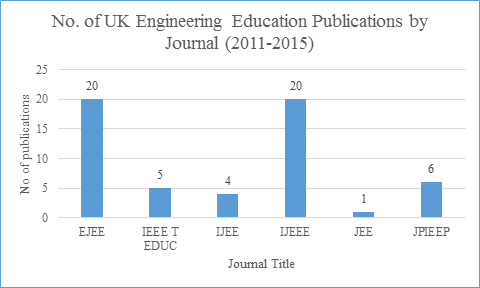
B: Distribution by Journal Title of Engineering Education Publications by UK-based Authors

Publications by Journal
Distribution of Publications by Journal Title

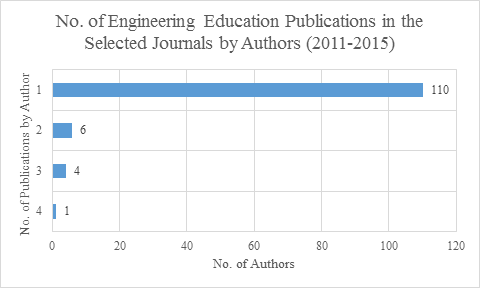
C: Distribution of UK-based Engineering Education Authors by Number of Publications

Publication by Author
Distribution of Authors by Number of Publications

UK Papers in Dedicated Engineering Education Journals for the 5 Year Period 2011-2015

Year 2011
[1] E. Alpay, A. L. Ahearn, and A. M. J. Bull, “Promoting cross-departmental initiatives for a global dimension in engineering education: the Imperial College experience,” European Journal of Engineering Education, vol. 36, pp. 225-242, 2011/06/01 2011.
[2] P. Brereton, “A Study of Computing Undergraduates Undertaking a Systematic Literature Review,” IEEE Transactions on Education, vol. 54, pp. 558-563, 2011.
[3] E. M. Clafferty, “Facilitating Social Networking within the Student Experience,” International Journal of Electrical Engineering Education, vol. 48, pp. 245-251, July 1, 2011 2011.
[4] J. L. Fernandez Aleman, D. Palmer-Brown, and C. Jayne, “Effects of Response-Driven Feedback in Computer Science Learning,” IEEE Transactions on Education, vol. 54, pp. 501-508, 2011.
[5] E. Gadd, A. Baldwin, M. Norris, and S. Reid, “Using the Evidence: Comparison of Civil and Building Lecturers’ and Students’ Approaches to the Literature Review,” Journal of Professional Issues in Engineering Education and Practice, vol. 138, pp. 114-122, 2011.
[6] C. S. Nair, A. Patil, and P. Mertova, “Enhancing the quality of engineering education by utilising student feedback,” European Journal of Engineering Education, vol. 36, pp. 3-12, 2011/03/01 2011.
[7] A. Nortcliffe and A. Middleton, “Smartphone Feedback: Using an iPhone to Improve the Distribution of Audio Feedback,” International Journal of Electrical Engineering Education, vol. 48, pp. 280-293, July 1, 2011.
[8] G. Perkin and S. Bamforth, “A variety of approaches to the provision of mathematics help for first-year engineering undergraduates,” International Journal of Electrical Engineering Education, vol. 48, pp. 79-91, 2011.
[9] J. A. Rossiter, “Which Technology Can Really Enhance Learning within Engineering?,” International Journal of Electrical Engineering Education, vol. 48, pp. 231-244, July 1, 2011.
[10] J. A. Rossiter, “Which Technology Can Really Enhance Learning within Engineering?,” International Journal of Electrical Engineering Education, vol. 48, pp. 231-244, July 1, 2011.
[11] M. Short and C. Cox, “RTE-SIM: A Simple, Low-Cost and Flexible Environment to Support the Teaching of Real-Time and Embedded Control,” International Journal of Electrical Engineering Education, vol. 48, pp. 339-358, October 1, 2011.

Year 2012
[12] E. Alpay and M. E. Jones, “Engineering education in research-intensive universities,” European Journal of Engineering Education, vol. 37, pp. 609-626, 2012/12/01 2012.
[13] J. Coombs, R. Prabhu, and G. Peake, “Overcoming the Challenges of Porting OpenCV to TI’s Embedded ARM + DSP Platforms,” International Journal of Electrical Engineering Education, vol. 49, pp. 260-274, July 1, 2012.
[14] N. Dahnoun and J. Brand, “Teaching DSP Implementation: The Big Picture,” International Journal of Electrical Engineering Education, vol. 49, pp. 202-209, July 1, 2012.
[15] J. W. Davies and U. Rutherford, “Learning from fellow engineering students who have current professional experience,” European Journal of Engineering Education, vol. 37, pp. 354-365, 2012/08/01 2012.
[16] P. Gaydecki, “The Foundations of Digital Signal Processing Using Signal Wizard Systems®,” International Journal of Electrical Engineering Education, vol. 49, pp. 310-320, July 1, 2012.
[17] J. Gimenez and J. Thondhlana, “Collaborative writing in engineering: Perspectives from research and implications for undergraduate education,” European Journal of Engineering Education, vol. 37, pp. 471-487, 2012/10/01 2012.
[18] R. Graham, “The One Less Traveled By: The Road to Lasting Systemic Change in Engineering Education,” Journal of Engineering Education, vol. 101, pp. 596-600, 2012.
[19] D. M. Laverty, J. Milliken, M. Milford, and M. Cregan, “Embedded C programming: a practical course introducing programmable microprocessors,” European Journal of Engineering Education, vol. 37, pp. 557-574, 2012/12/01 2012.
[20] A. Powell, A. Dainty, and B. Bagilhole, “Gender stereotypes among women engineering and technology students in the UK: lessons from career choice narratives,” European Journal of Engineering Education, vol. 37, pp. 541-556, 2012/12/01 2012.
[21] I. Schagaev, N. Folic, N. Ioannides, and E. Bacon, “Multiple choice answers approach: assessment with penalty function for computer science and similar disciplines,” The International journal of engineering education, vol. 28, pp. 1294-1300, 2012.
[22] F. Soltani, D. Twigg, and J. Dickens, “Sponsorship Works: Study of the Perceptions of Students, Employers, and Academics of Industrial Sponsorship,” Journal of Professional Issues in Engineering Education and Practice, vol. 139, pp. 171-176, 2012.
[23] F. Soltani, D. Twigg, and J. Dickens, “Setting up University-Industry Links through Sponsoring Undergraduate Engineering Programmes,” International Journal of Engineering Education, vol. 28, pp. 572-578, 2012.
[24] F. Soltani, D. Twigg, and J. Dickens, “Industry Input into the Education of Undergraduate Engineering Students through Sponsorship,” International Journal of Engineering Education, vol. 28, pp. 982-988, 2012.
[25] J. X. Wang, A. F. Zobaa, Z. H. Bie, and D. Z. Xia, “From Mathematical Analysis to Experimental Calculation: Teaching Three-Phase Short-Circuits of a Synchronous Generator,” International Journal of Electrical Engineering Education, vol. 49, pp. 444-463, October 1, 2012.

Year 2013
[26] E. Alpay, “Student attraction to engineering through flexibility and breadth in the curriculum,” European Journal of Engineering Education, vol. 38, pp. 58-69, 2013/03/01 2013.
[27] J. Apsley, “An Autonomous Line-Following Robot Project as a Training Tool for Project Work,” International Journal of Electrical Engineering Education, vol. 50, pp. 239-246, July 1, 2013.
[28] J. Carrasco, W. P. Heath, M. C. R. Liñan, R. Alli-Oke, O. A. R. A. Kerim, and S. R. Gutierrez, “Themed Project Case Study: Quadruple Tanks Control with PLCs,” International Journal of Electrical Engineering Education, vol. 50, pp. 279-292, July 1, 2013.
[29] G. Cielniak, N. Bellotto, and T. Duckett, “Integrating Mobile Robotics and Vision With Undergraduate Computer Science,” IEEE Transactions on Education, vol. 56, pp. 48-53, 2013.
[30] I. Cotton and M. Barnes, “The Power Engineering Guide: A Mobile Application for Education and Wider Engagement,” International Journal of Electrical Engineering Education, vol. 50, pp. 247-255, July 1, 2013.
[31] R. M. Crowder and K. P. Zauner, “A Project-Based Biologically-Inspired Robotics Module,” IEEE Transactions on Education, vol. 56, pp. 82-87, 2013.
[32] H. C. Davies, “Formula student as part of a mechanical engineering curriculum,” European Journal of Engineering Education, vol. 38, pp. 485-496, 2013/10/01 2013.
[33] S. Durovic, “Development of a Simple Interactive Laboratory Exercise for Teaching the Principles of Velocity and Position Estimation,” International Journal of Electrical Engineering Education, vol. 50, pp. 256-267, July 1, 2013.
[34] P. Gaydecki, “High-Precision Digital Audio Waveform Synthesis Using a Multi-Frequency Interpolation Technique,” International Journal of Electrical Engineering Education, vol. 50, pp. 293-303, July 1, 2013.
[35] M. Gillie, T. Stratford, L. Bisby, and A. Furber, “Trebuchets and bridges: Reconnecting structural education with the real world,” Journal of Professional Issues in Engineering Education and Practice, vol. 140, p. 02513003, 2013.
[36] M. Gillie, T. Stratford, and O. Broadbent, “Creative conceptual design teaching: It’s not about rebar curtailment!,” Journal of Professional Issues in Engineering Education and Practice, vol. 140, p. 02513004, 2013.
[37] P. R. Green, P. N. Green, M. Bailey, and D. A. Foster, “Design and Delivery of a Microcontroller Engineering Teaching Theme,” International Journal of Electrical Engineering Education, vol. 50, pp. 230-238, July 1, 2013.
[38] M. G. Hartley, “The International Journal of Electrical Engineering Education at its Half-Century,” International Journal of Electrical Engineering Education, vol. 50, pp. 341-344, July 1, 2013.
[39] W. P. Heath, O. Onel, P. M. Green, B. Lennox, Z. Gai, Z. He, et al., “Developing a Student—Focused Undergraduate Laboratory,” International Journal of Electrical Engineering Education, vol. 50, pp. 268-278, July 1, 2013.
[40] K. Kopsidas, M. Pampaka, and S. Knowles, “Students’ Perceptions of the ‘With Industrial Experience’ Degree Pathway in Electrical and Electronic Engineering,” International Journal of Electrical Engineering Education, vol. 50, pp. 217-229, July 1, 2013.
[41] J. A. Rossiter, “Case studies in making assessment efficient while developing student professionalism and managing transition,” European Journal of Engineering Education, vol. 38, pp. 582-594, 2013/12/01 2013.
[42] L. Scott and C. Fortune, “Towards the improvement of the student experience of assessment and feedback in construction management education,” European Journal of Engineering Education, vol. 38, pp. 661-670, 2013/12/01 2013.
[43] E. Sorensen, “Implementation and student perceptions of e-assessment in a Chemical Engineering module,” European Journal of Engineering Education, vol. 38, pp. 172-185, 2013/05/01 2013.
[44] H. Wade, “National Instruments and the University of Manchester, School of Electrical and Electronic Engineering: A Strategic Partnership for Engineering Education,” International Journal of Electrical Engineering Education, vol. 50, pp. 304-315, July 1, 2013.

Year 2014
[45] E. Alpay and R. Verschoor, “The teaching researcher: faculty attitudes towards the teaching and research roles,” European Journal of Engineering Education, vol. 39, pp. 365-376, 2014/07/04 2014.
[46] R. Clark and J. Andrews, “Relationships, variety & synergy: the vital ingredients for scholarship in engineering education? A case study,” European Journal of Engineering Education, vol. 39, pp. 585-600, 2014/11/02 2014.
[47] X. Danos, R. Barr, R. Górska, and E. Norman, “Curriculum planning for the development of graphicacy capability: three case studies from Europe and the USA,” European Journal of Engineering Education, vol. 39, pp. 666-684, 2014/11/02 2014.
[48] S. Donohue, “Supporting active learning in an undergraduate geotechnical engineering course using group-based audience response systems quizzes,” European Journal of Engineering Education, vol. 39, pp. 45-54, 2014/01/02 2014.
[49] J. Gilford, R. E. Falconer, R. Wade, and K. C. Scott-Brown, “3D visualisation and artistic imagery to enhance interest in ‘hidden environments’ – new approaches to soil science,” European Journal of Engineering Education, vol. 39, pp. 467-482, 2014/09/03 2014.
[50] P. Godfrey, R. Deakin Crick, and S. Huang, “Systems Thinking, Systems Design and Learning Power in Engineering Education,” The International Journal of Engineering Education, vol. 30, 2014.
[51] M. J. Scott and G. Ghinea, “On the Domain-Specificity of Mindsets: The Relationship Between Aptitude Beliefs and Programming Practice,” IEEE Transactions on Education, vol. 57, pp. 169-174, 2014.
[52] M. Walker and J. Williams, “Critical evaluation as an aid to improved report writing: a case study,” European Journal of Engineering Education, vol. 39, pp. 272-281, 2014/05/04 2014.

Year 2015
[53] A. A. Anwar and D. J. Richards, “The Washington Accord and US Licensing Boards,” Journal of Professional Issues in Engineering Education and Practice, vol. 141, p. 04015001, 2015.
[54] G. A. Bingham, D. J. Southee, and T. Page, “Meeting the expectation of industry: an integrated approach for the teaching of mechanics and electronics to design students,” European Journal of Engineering Education, vol. 40, pp. 410-431, 2015/07/04 2015.
[55] M. Gillie, D. Moore, N. Caron, and T. Mansfield-Williams, “Engineering Art: Experiences of an Innovative Learning Week Activity,” Journal of Professional Issues in Engineering Education and Practice, vol. 141, p. 02515001, 2015.
[56] J. Orr, T. Ibell, M. Evernden, and A. Darby, “Day one sustainability,” European Journal of Engineering Education, vol. 40, pp. 285-296, 2015/05/04 2015.

Engineering Education: Potential Journals in Which to Publish

https://orcid.org/0000-0001-8976-6202

Journals and conferences dedicated to engineering education offer an opportunity for academics and researchers to share ideas, experiences and innovations in engineering education. Often, however, those starting out to publish in engineering education, and those engineering academics who simply want to inform and improve their own learning and teaching practice, do not always know where to turn to. This is mainly because engineering education journals are still relatively few and largely unknown to the majority of engineering educators. And since journals dedicated to engineering education are so few and so unknown, those engineering educators who are currently publishing are doing so largely through mainstream education journals. This has led to a diffusion and dilution of engineering education research into a plethora of education journals which are largely beyond the radar of the ordinary engineering academic.

In this article I present a shortlist of seven engineering education journals that the aspiring engineering education researcher can publish in. I arrive at this list using the following standard journal evaluation criteria: journal impact factor, the SCImago Journal Ranking, h-index and number of indexing databases.

My effort builds on the work by Van Epps (2013), and by Shawcross and Ridgman (2013), who both independently set out to identify and draw up shortlists of journals, both engineering education and mainstream, that engineering education researchers can publish in. I strongly believe that a quantum leap in the impact and visibility of engineering education research can only be attained through focused publication in dedicated engineering education journals.  Hence, in contrast to these two publications, my focus is on engineering education journals only.

  1. Journal Listing based on the Thomson Reuters 2014 Journal Impact Factor

Eugene Garfield, the originator of the journal impact factor  explains it as follows (Garfield, 2006) : “A journal’s impact factor is based on 2 elements: the numerator, which is the number of citations in the current year to any items published in a journal in the previous 2 years, and the denominator, which is the number of substantive articles (source items) published in the same 2 years.”

Below is an ordered list of engineering education journals that I retrieved from the 2014 Thomson Reuters InCites Journal Citation Report and ordered according to their journal impact factor (Table 1):

Table 1: Journals ranked by their Journal Impact Factor (JIF)

RankTitleISSNJIFCountry
1Journal of Engineering EducationISSN 216898302.059United States
2Research in Engineering Design – Theory, Applications, and Concurrent EngineeringISSN 143560661.233United Kingdom
3IEEE Transactions on EducationISSN 001893590.842United States
4Engineering StudiesISSN 193786290.5United Kingdom
5Journal of Professional Issues in Engineering Education and PracticeISSN 105239280.275United States
6International Journal of Electrical Engineering EducationISSN 002072090.077United Kingdom
  1. Journal Listing based on the 2014 SJR Journal Rankings

The SCImago Journal Ranking (SJR) is a size-independent indicator of scientific journal prestige computed by weighting the number of citations received by a journal by the prestige of the citing journals (Guerrero-Bote & Moya-Anegón, 2012).

Below is an ordered list of engineering education journal titles that I retrieved from the 2014 SJR journal rankings list and ordered according to their SJR rankings (Table 2):

Table 2: Journals ranked by their SCImago Journal Ranking (SJR)

RankTitleISSNSJRCountry
1Journal of Engineering EducationISSN 216898301.705United States
2Research in Engineering Design – Theory, Applications, and Concurrent EngineeringISSN 143560661.286United Kingdom
3IEEE Transactions on EducationISSN 001893590.68United States
4Journal of Professional Issues in Engineering Education and PracticeISSN 105239280.449United States
5European Journal of Engineering EducationISSN 146958980.419United Kingdom
6Engineering StudiesISSN 193786290.377United Kingdom
7Computer Applications in Engineering EducationISSN 109905420.315United States
8International Journal of Engineering EducationISSN 0949149X0.314Ireland
9Chemical Engineering EducationISSN 000924790.293United States
10Advances in Engineering EducationISSN 194117660.23United States
11International Journal of Continuing Engineering Education and Life-Long LearningISSN 174150550.183United Kingdom
12Global Journal of Engineering EducationISSN 132831540.181Australia
13International Journal of Electrical Engineering EducationISSN 002072090.168United Kingdom
14International Journal of Mechanical Engineering EducationISSN 205045860.166United Kingdom
15Engineering EducationISSN 175000440.152United Kingdom
16Australasian Journal of Engineering EducationISSN 132458210.11Australia
  1. Journal Listing based on the 2014 H-Index

The h-index is defined as “the number of papers with citation number ≥ h.” (Hirsch, 2005). The journal h-index over a given period, say a year, is obtained by ranking all the source items of the given journal over the specified period in accordance with the number of “Times Cited.” The journal h-index for the specified period is the highest rank number lower than the “Times Cited” value (Braun, Glänzel & Schubert, 2005).

Below is an ordered list of engineering education journal titles that I retrieved from the 2014 SJR journal rankings list and ordered according to their h-index (Table 3):

Table 3: Journals ranked by their h-Index

RankingJournal TitleISSNH indexCountry
1Journal of Engineering EducationISSN 2168983062United States
2IEEE Transactions on EducationISSN 0018935948United States
3Research in Engineering Design – Theory, Applications, and Concurrent EngineeringISSN 1435606646United Kingdom
4International Journal of Engineering EducationISSN 0949149X30Ireland
5Journal of Professional Issues in Engineering Education and PracticeISSN 1052392823United States
6Computer Applications in Engineering EducationISSN 1099054218United States
7Chemical Engineering EducationISSN 0009247918United States
8European Journal of Engineering EducationISSN 1469589815United Kingdom
9International Journal of Continuing Engineering Education and Life-Long LearningISSN 1741505514United Kingdom
10International Journal of Electrical Engineering EducationISSN 0020720914United Kingdom
11Engineering StudiesISSN 1937862910United Kingdom
12Advances in Engineering EducationISSN 194117669United States
13International Journal of Mechanical Engineering EducationISSN 205045867United Kingdom
14Global Journal of Engineering EducationISSN 132831543Australia
15Engineering EducationISSN 175000443United Kingdom
16Australasian Journal of Engineering EducationISSN 132458211Australia
  1. Journal Listing based on Database Indexing

Journals are often indexed on several databases to ensure that their articles are available to a wide audience. Examples of indexing databases include ERIC, Education Full-text, Compendex, INSPEC, Web of Knowledge, Scopus and the Professional Development Collection.

Van Epps (2013) ordered the journals in which engineering  education research is published by the number of databasesto which they are indexed. Below is an ordered list of indexed journals dedicated to engineering education that I have extracted from the list by Van Epps (Table 4):

Table 4: Journals ranked by number of indexing databases

RankingJournal TitleISSNNo. of Indexed DatabasesCountry
1International Journal of Electrical Engineering EducationISSN 002072095United Kingdom
2IEEE Transactions on EducationISSN 001893595United States
3Journal of Engineering EducationISSN 216898304United States
4International Journal of Engineering EducationISSN 0949149X4Ireland
  1. Approach to Obtaining Overall Journal Ranking

I used the following ranking scheme to obtain my shortlist of top engineering education journals to publish in. Points were allocated to each journal in each of the tables listed above as follows (Table 5):

Table 5: Journal Scoring Formula

Table RankingPoints Awarded
15
24
33
42
51
Outside top 5 ranking0

To facilitate ranking, I decided that if any of the journals got the same overall score, then the one that scored one or more points across more tables would be ranked higher.

Table 6: Journals ranked by their overall score

Journal TitleISSNCountryJIF PointsH Index PointsSJR PointsIndex PointsOverall Score
Journal of Engineering EducationISSN 21689830United States555318
IEEE Transactions on EducationISSN 00189359United States443516
Research in Engineering Design – Theory, Applications, and Concurrent EngineeringISSN 14356066United Kingdom13408
International Journal of Electrical Engineering EducationISSN 00207209United Kingdom30058
Journal of Professional Issues in Engineering Education and PracticeISSN 10523928United States21205
International Journal of Engineering EducationISSN 0949149XIreland02035
European Journal of Engineering EducationISSN 14695898United Kingdom00101
Computer Applications in Engineering EducationISSN 10990542United States00000
Chemical Engineering EducationISSN 00092479United States00000
International Journal of Continuing Engineering Education and Life-Long LearningISSN 17415055United Kingdom00000
Engineering StudiesISSN 19378629United Kingdom00000
Advances in Engineering EducationISSN 19411766United States00000
International Journal of Mechanical Engineering EducationISSN 20504586United Kingdom00000
Global Journal of Engineering EducationISSN 13283154Australia00000
Engineering EducationISSN 17500044United Kingdom00000
Australasian Journal of Engineering EducationISSN 13245821Australia00000
  1. Final Shortlist of dedicated engineering education journals

My final list comprised all the journals that had an overall score of one point or more.

Table 7: My Top Journals dedicated to Engineering Education

 RankJournal TitleISSNCountryJournal Website Link
1Journal of Engineering EducationISSN 21689830United Stateshttp://onlinelibrary.wiley.com/journal/10.1002/(ISSN)2168-9830
2IEEE Transactions on EducationISSN 00189359United Stateshttp://ieeexplore.ieee.org/xpl/RecentIssue.jsp?punumber=13
3Research in Engineering Design – Theory, Applications, and Concurrent EngineeringISSN 14356066United Kingdomhttp://www.springer.com/engineering/mechanical+engineering/journal/163
4International Journal of Electrical Engineering EducationISSN 00207209United Kingdomhttps://uk.sagepub.com/en-gb/eur/journal/international-journal-electrical-engineering-education
5Journal of Professional Issues in Engineering Education and PracticeISSN 10523928United Stateshttp://ascelibrary.org/journal/jpepe3
6International Journal of Engineering EducationISSN 0949149XIrelandhttp://www.ijee.ie/


7European Journal of Engineering EducationISSN 14695898United Kingdomhttp://www.tandfonline.com/toc/ceee20/current

References

BORREGO, M., & BERNHARD, J. (2011). The Emergence of Engineering Education Research as an Internationally Connected Field of Inquiry. Journal of Engineering Education100(1), 14-47.

Braun, T., Glänzel, W., & Schubert, A. (2005). A Hirsch-type index for journals. The scientist19(22), 8.

Garfield, E. (2006). The history and meaning of the journal impact factor.Jama295(1), 90-93.

Guerrero-Bote, V. P., & Moya-Anegón, F. (2012). A further step forward in measuring journals’ scientific prestige: The SJR2 indicator. Journal of Informetrics6(4), 674-688.

Hirsch, J. E. (2005). An index to quantify an individual’s scientific research output. Proceedings of the National academy of Sciences of the United States of America102(46), 16569-16572.

Shawcross, J., & Ridgman, T. (2013). Publishing Engineering Education Research, HEA Academy Working Paper. Higher Education Academy.

Van Epps, A. S. (2013). Beyond JEE: Finding publication venues to get your message to the ‘right’ audience. 120th ASEE Annual Conference June 2013, Paper 5859.